Article: Washington and Lincoln: “Columbia’s Noblest Sons”
Washington and Lincoln: “Columbia’s Noblest Sons”

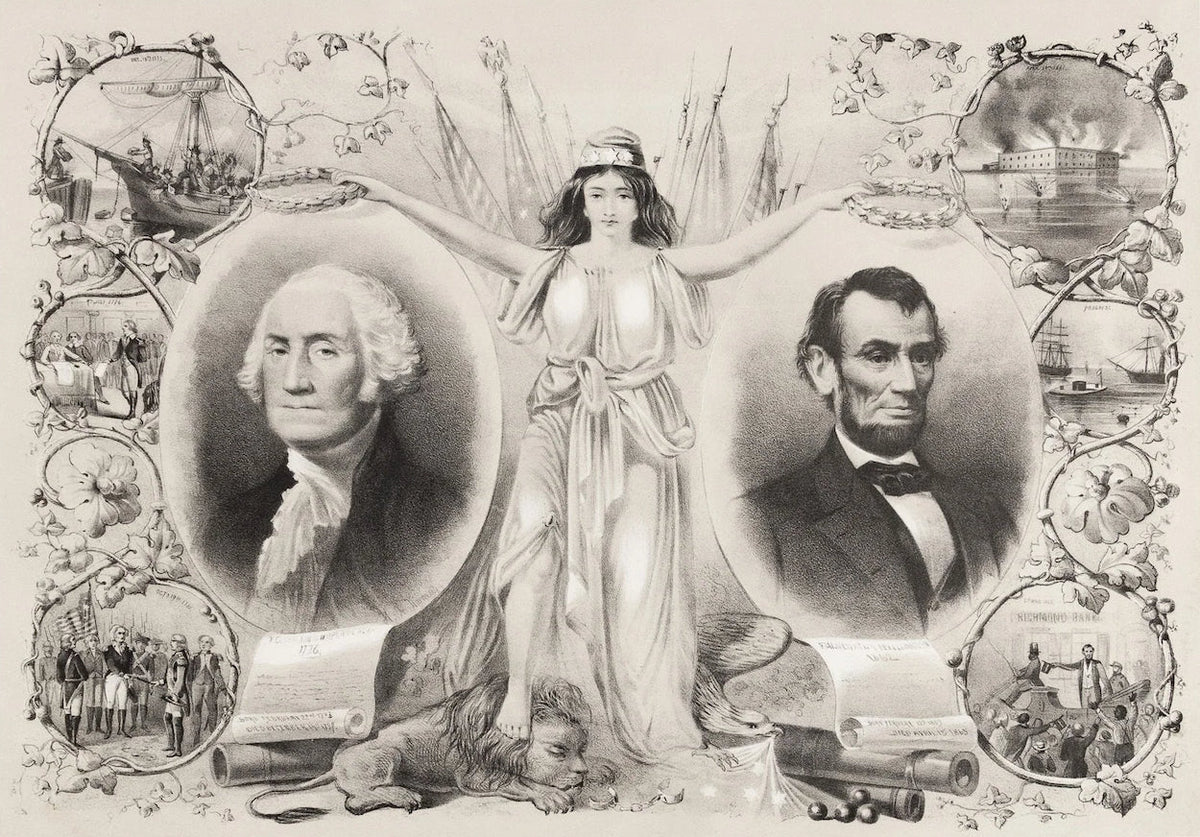
New to our collection is an original 1865 memorial lithograph entitled “Columbia’s Noblest Sons,” an evocative example of the visual culture that emerged in the immediate aftermath of Abraham Lincoln’s assassination. Published in New York by Henry and William Voight, printed by Kummel & Forster, and sold by Manson Lang, the print brings together George Washington and Abraham Lincoln as the two defining figures in the creation and preservation of the American republic.
The composition is centered on Columbia, personified as a classical figure wearing a Phrygian cap, who crowns both Presidents with laurel wreaths. Washington, the “Father of his Country,” appears alongside scenes from the American Revolution, including the Boston Tea Party, the signing of the Declaration of Independence, and the surrender of Cornwallis at Yorktown. These are mirrored on Lincoln’s side by episodes from the Civil War: the bombardment of Fort Sumter, the encounter between the Monitor and Merrimac, and Lincoln’s arrival in Richmond on April 6, 1865. Beneath Washington appears the Declaration of Independence, while Lincoln is accompanied by the Emancipation Proclamation. At the center, the Goddess of Liberty triumphs over tyranny and rebellion, with broken shackles symbolizing the destruction of slavery. An American eagle rises behind her, while a fallen British lion and scattered implements of war reinforce the imagery of national victory. Lincoln’s portrait is based on the celebrated photograph taken by Anthony Berger at Mathew Brady’s Washington gallery on February 9, 1864, an image subsequently adapted for the five-dollar bill.
The pairing of Washington and Lincoln was particularly significant in the months following Lincoln’s assassination. Washington had long occupied the position of the nation’s preeminent civic hero, famously described as “first in the hearts of his countrymen.” In "Columbia’s Noblest Sons," Lincoln is deliberately elevated to the same symbolic plane. The visual correspondence between the two Presidents suggests a continuity of national purpose: Washington established the republic through the Revolution, while Lincoln preserved the Union through the Civil War and associated its survival with the destruction of slavery.

A surviving circular prospectus issued by Manson Lang provides an unusually detailed contemporary description of the print and illustrates how it was presented to the public in 1865. It declares that the work was “executed in the highest style of the Art,” and describes the composition as being “in perfect harmony with the enthusiastic spirit of the times” and reflective of the “zeal and patriotic devotion of the hour.” The prospectus gives the print its full interpretive framework, calling Washington “the Father of his Country” and Lincoln “its Savior.” It explains that, “In the centre of the piece is the ‘Goddess of Liberty,’ crushing to earth the monster of tyranny and rebellion,” with Washington at her right and Lincoln at her left, while she places upon each “the Nation’s fadeless crown of immortal honor.” The prospectus concludes by describing the work as “one of the most complete and beautiful works of Art ever presented for the admiration of the American people.”
Measuring approximately 19 by 24 inches, it was among the larger popular memorial engravings issued in the aftermath of Lincoln’s death. It was originally offered for one dollar, a price the prospectus emphasized placed the memorial “within the reach of all.” Memorial prints of both Washington and Lincoln, like the one seen here, "provided the strongest evidence yet that George Washington and Abraham Lincoln had emerged from the crisis as peerless, unique symbols of a country made and remade in the crucible of war" (Holzer, 1994).
REFERENCES:
Holzer, Harold. “Columbia’s Noblest Sons: Washington and Lincoln in Popular Prints.” Journal of the Abraham Lincoln Association 15, no. 1 (1994): 23–69.
Manson, Lang. “Columbia’s Noblest Sons”: Printed Circular Seeking Agents to Sell Patriotic Print Celebrating Union Victory. New York, 1866.