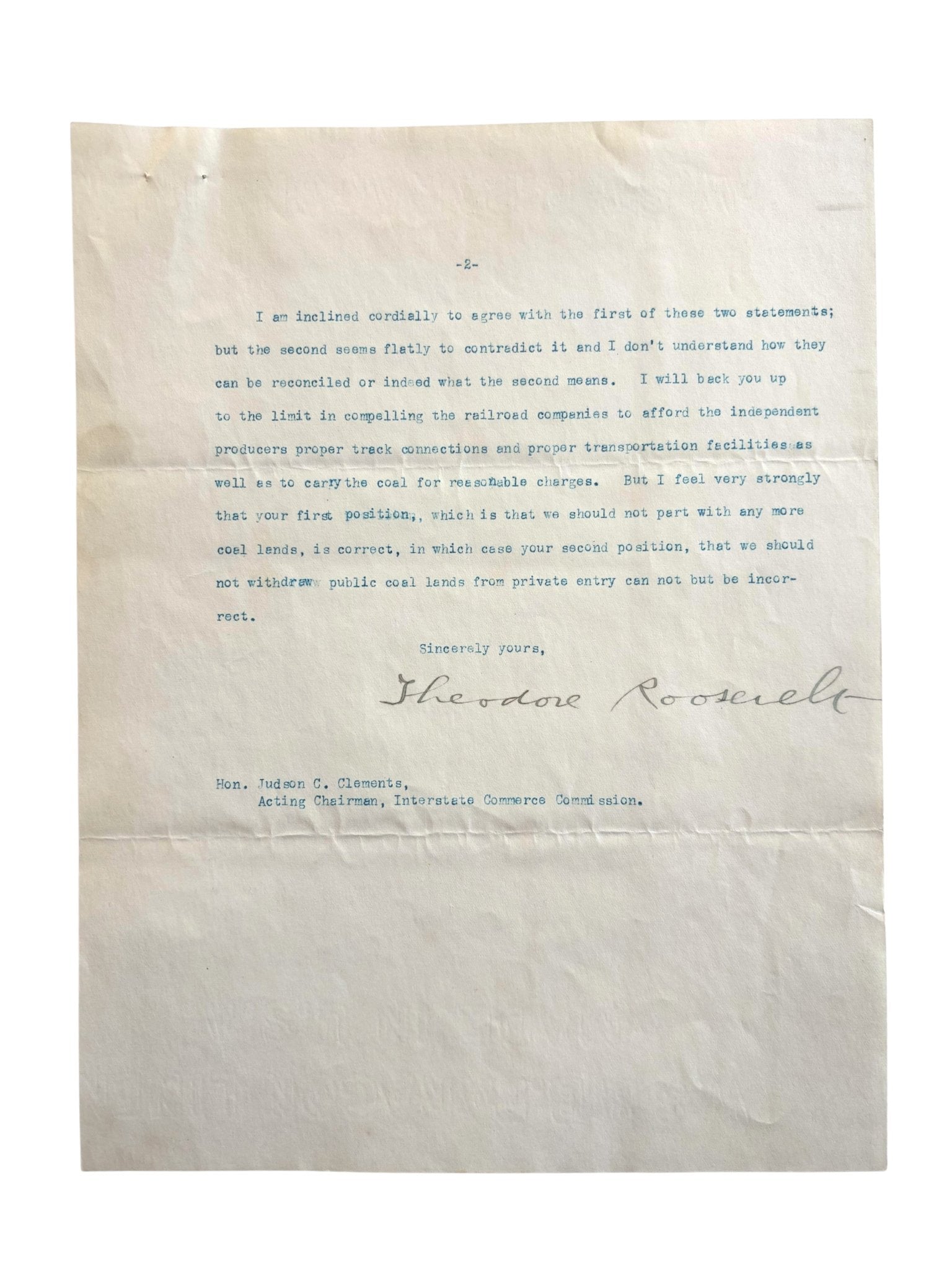
Theodore Roosevelt Signed Typed Letter, Dated October 13, 1906
This typed and signed presidential letter captures Theodore Roosevelt at the height of his Progressive crusade against railroad power and industrial monopolies. Written from the White House on October 13, 1906, Roosevelt addresses Judson C. Clements, Acting Chairman of the Interstate Commerce Commission, and engages directly with the problem of railroad-controlled coal monopolies. Roosevelt responds to Clements’ previous report on the Union Pacific coal investigation and sharply questions what he sees as a contradiction in Clements’ analysis.
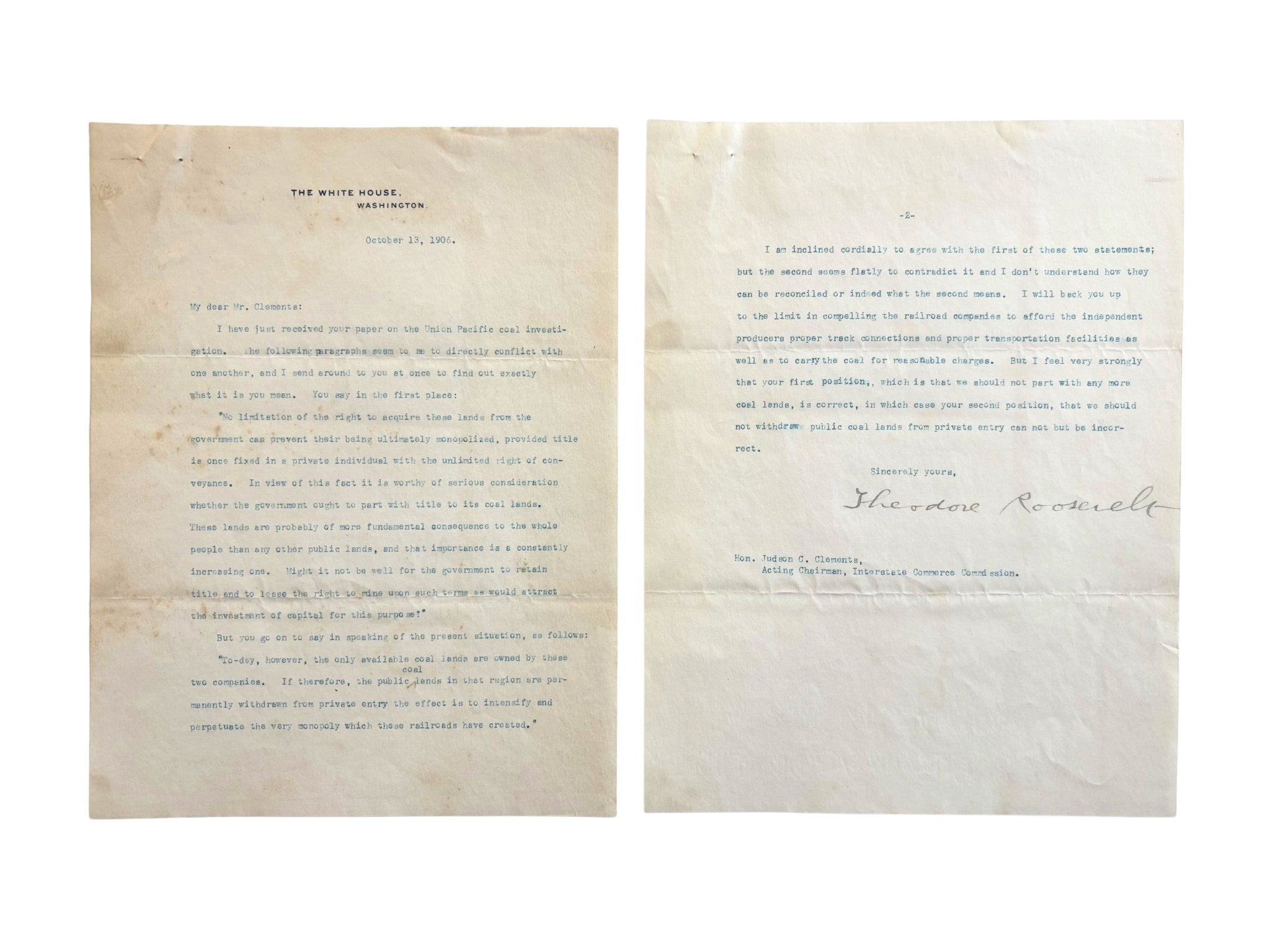
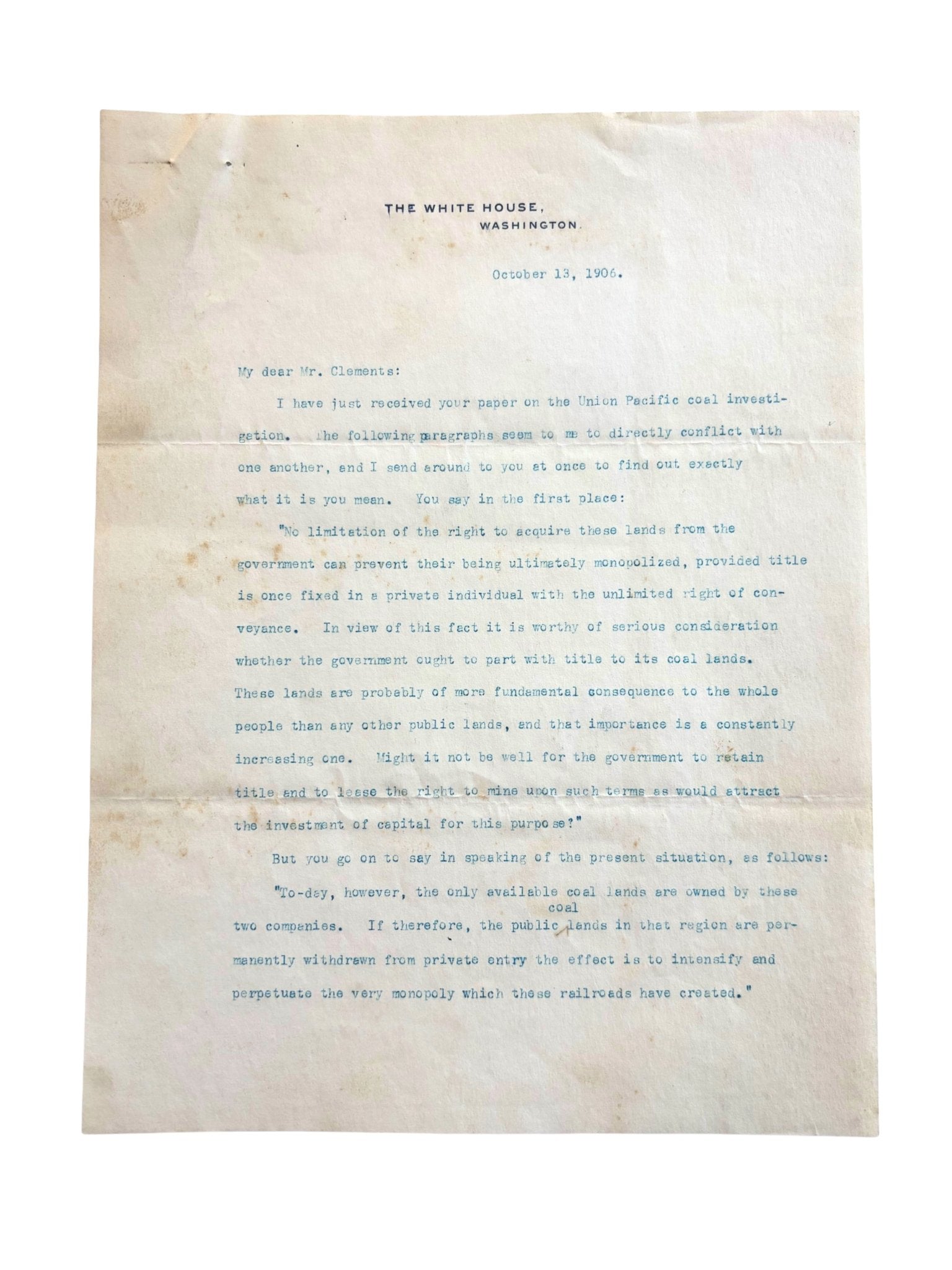
The letter reads, in full:
My dear Mr. Clements:
I have just received your paper on the Union Pacific coal investigation. The following paragraphs seem to me to directly conflict with one another, and I send around to you at once to find out exactly what it is you mean. You say in the first place:
“No limitation of the right to acquire these lands from the government can prevent their being ultimately monopolized, provided title is once fixed in a private individual with the unlimited right of conveyance. In view of this fact it is worthy of serious consideration whether the government ought to part with title to its coal lands. These lands are probably of more fundamental consequence to the whole people than any other public lands, and that importance is a constantly increasing one. Might it not be well for the government to retain title and to lease the right to mine upon such terms as would attract the investment of capital for this purpose?”
But you go on to say in speaking of the present situation, as follows:
“Today, however, the only available coal lands are owned by these two companies. If therefore, the public lands in that region are permanently withdrawn from private entry the effect is to intensify and perpetuate the very monopoly which these railroads have created.”
I am inclined cordially to agree with the first of these two statements; but the second seems flatly to contradict it and I don’t understand how they can be reconciled or indeed what the second means. I will back you up to the limit in compelling the railroad companies to afford the independent producers proper track connections and proper transportation facilities as well as to carry the coal for reasonable charges. But I feel very strongly that your first position which is that we should not part with anymore coal lands, is correct, in which case your second position, that we should not withdraw public coal lands from private entry can not but be incorrect.
Sincerely yours, Theodore Roosevelt
Roosevelt endorses the argument that coal lands are among the most vital of the nation’s public resources, warning that once title passes into private hands they inevitably fall under monopoly control. He presses the case that the federal government should retain ownership of coal lands and lease mining rights under terms that would invite private capital while preserving public control, a position reflecting his broader belief that natural resources must be managed for the long-term benefit of the entire nation.
The letter was written just over three months after Roosevelt signed the Hepburn Act of 1906, one of the most significant regulatory laws of the Progressive Era. The act dramatically strengthened the Interstate Commerce Commission by granting it real authority to set maximum railroad rates and regulate discriminatory practices. At the time, Roosevelt was deeply engaged in confronting the entanglement of railroads with coal companies, arrangements that allowed railroads to dominate fuel supplies and push out independent producers. In this letter he pledges unequivocal support for the ICC, promising to back Clements “to the limit.” His aim was to compel railroads to provide fair track connections, adequate transportation facilities, and reasonable rates for independent coal operators. Roosevelt added insistence that the nation “should not part with any more coal lands” underscores his growing concern over resource conservation in an era in which Americans were increasingly dependent on rail transport and coal energy.
This correspondence reflects Roosevelt’s active leadership during his second term, when he was translating antitrust ideals into practical regulation. Fresh from landmark victories like the dissolution of Northern Securities, Roosevelt used the government to assert authority over both corporations and natural resources, balancing private enterprise with public stewardship.
Judson C. Clements was a pivotal figure for Roosevelt to address. A former Confederate soldier turned lawyer and legislator, Clements spent decades shaping railroad regulation. He helped draft Georgia’s railroad laws, served ten years in Congress, and was one of the architects of the legislation that originally created the Interstate Commerce Commission. Appointed to the ICC in 1892, he was repeatedly reappointed by presidents of both parties and was widely regarded as one of the commission’s most forceful advocates for government authority over the railroads. In 1906, while serving as Acting Chairman during a critical transition period, Clements was deeply involved in investigations that directly tested the new powers granted by the Hepburn Act.
CONDITION:
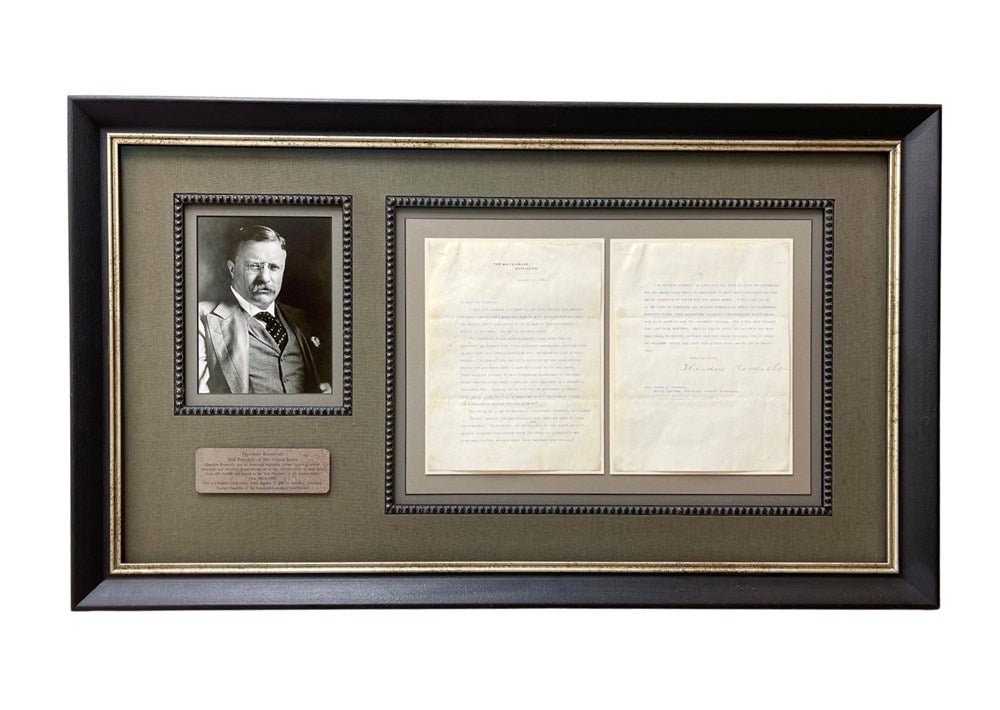
Near fine condition. Typed Letter Signed, to Judson C. Clements, dated October 13, 1906, Washington, D.C. On “The White House” letterhead. 2 pp. Typed in blue ink, signed in black ink on bottom right of second page. Signature is bold and legible, without smudges. Scattered toning and light foxing, heavier to the first page; staple holes to the upper left corners. Each page measures ~10 ¼” H x 8” W.
Archivally framed to conservation standards with acid-free mats, black beaded fillets, linen top mat, UV Conservation Clear glass, and a custom-built black and brushed gold frame.
Framed Dimensions: 22 1/2” H x 38 1/4” W x 1 7/8” D.
Accompanied by our company's letter of authenticity.
Pickup available at Colorado
Usually ready in 4 hours
Theodore Roosevelt Signed Typed Letter, Dated October 13, 1906
Colorado
1 Lake Avenue
Colorado Springs CO 80906
United States
Choose options
Frequently Asked Questions
FAQs
Yes, all of our Antiques are certified authentic. Every antique comes with a signed Letter of Authenticity that details the item’s history, its current condition including any conservation, binding, or framing work, and the item’s provenance. The Letters of Authenticity are priced valuations by our authentication specialists, who assure that items are original and unconditionally guaranteed as genuine for life.
We pack and ship your items from our gallery in Colorado Springs. You may also choose to come pick up your order. Antique items are carefully packed and insured during shipping. The shipping price will be calculated at checkout.
We acquire from a variety of trusted sources all over the world, but mostly through auctions and private collections within the United States. All provenance information will be listed on the Letter of
Authenticity accompanying your purchase.