
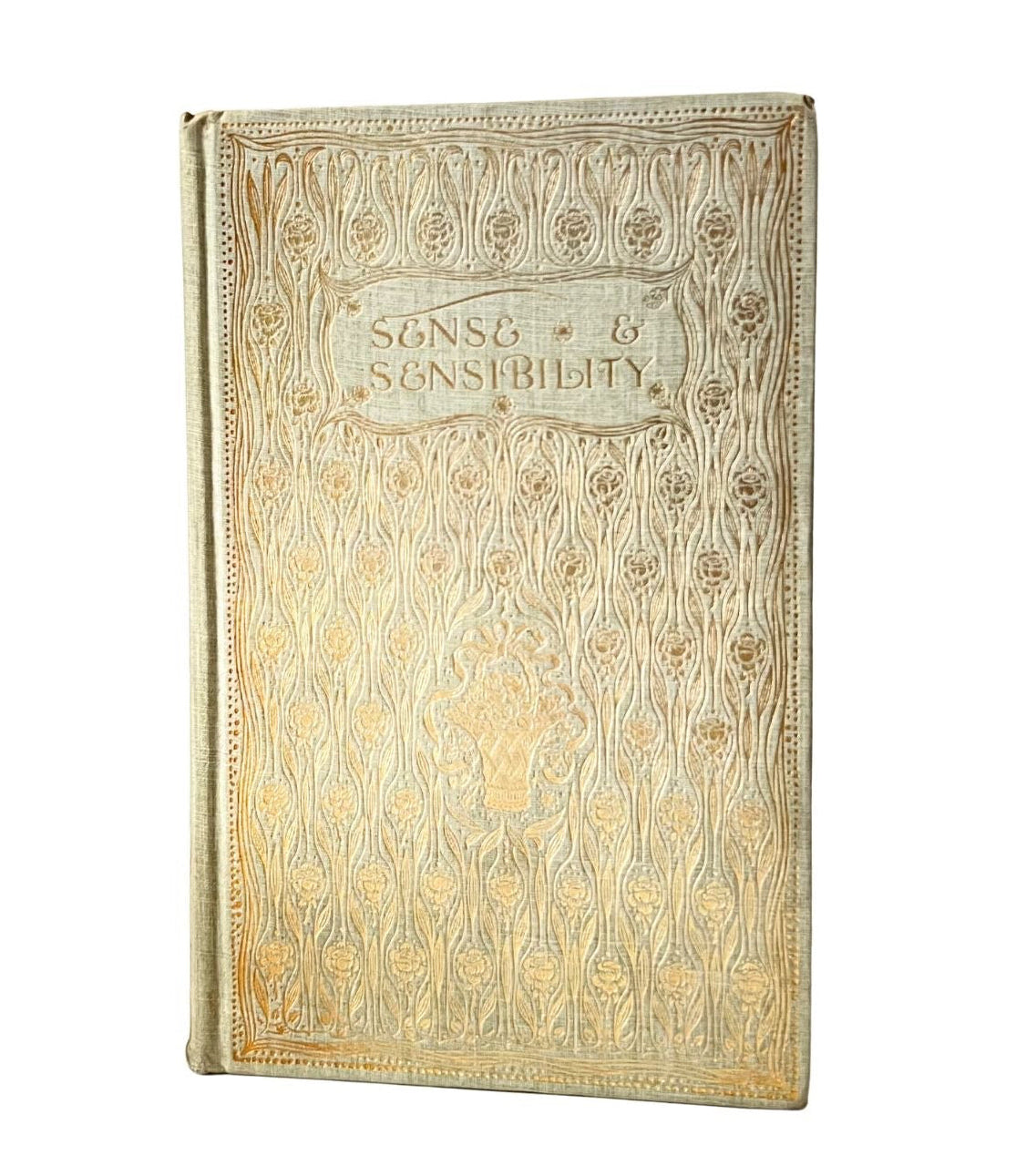

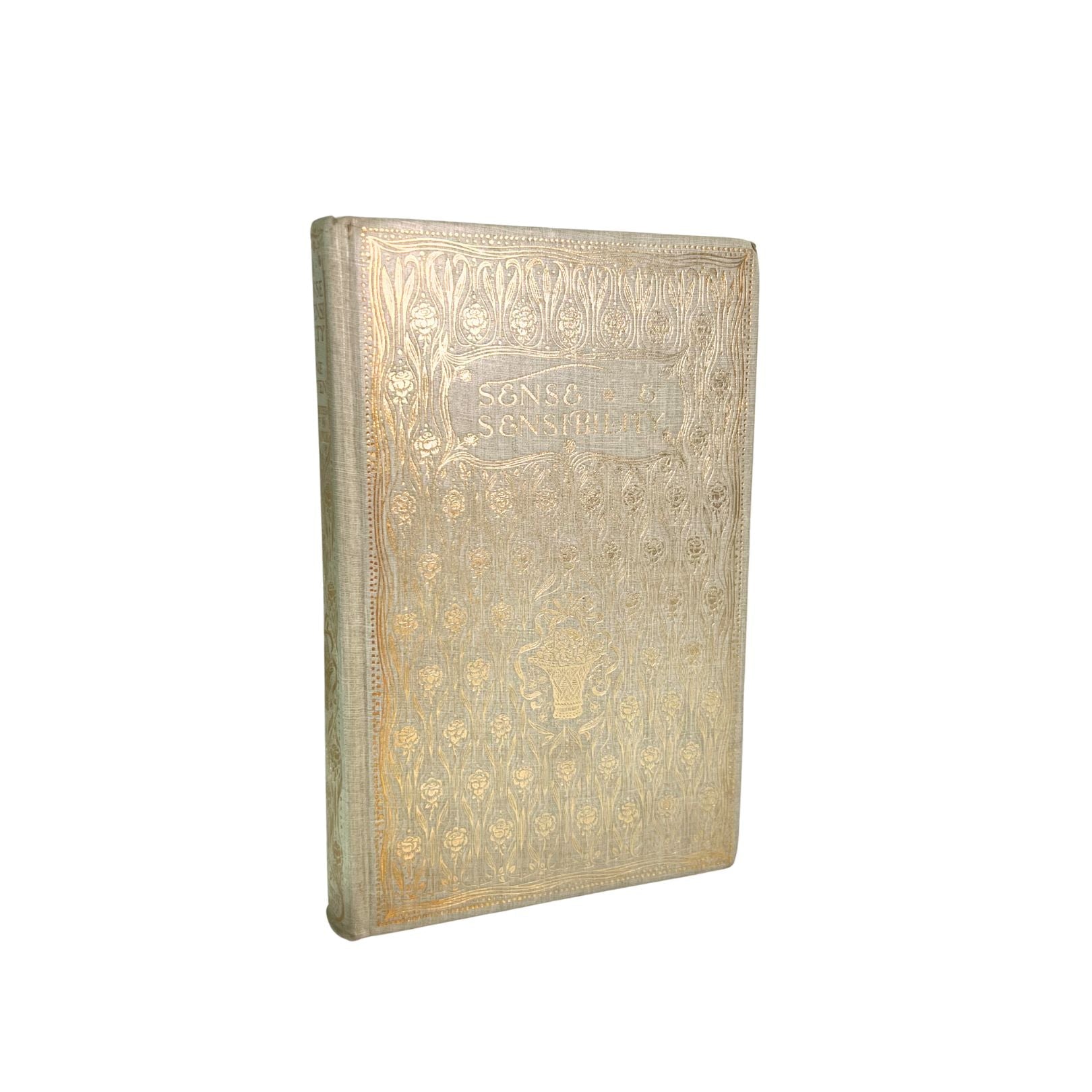
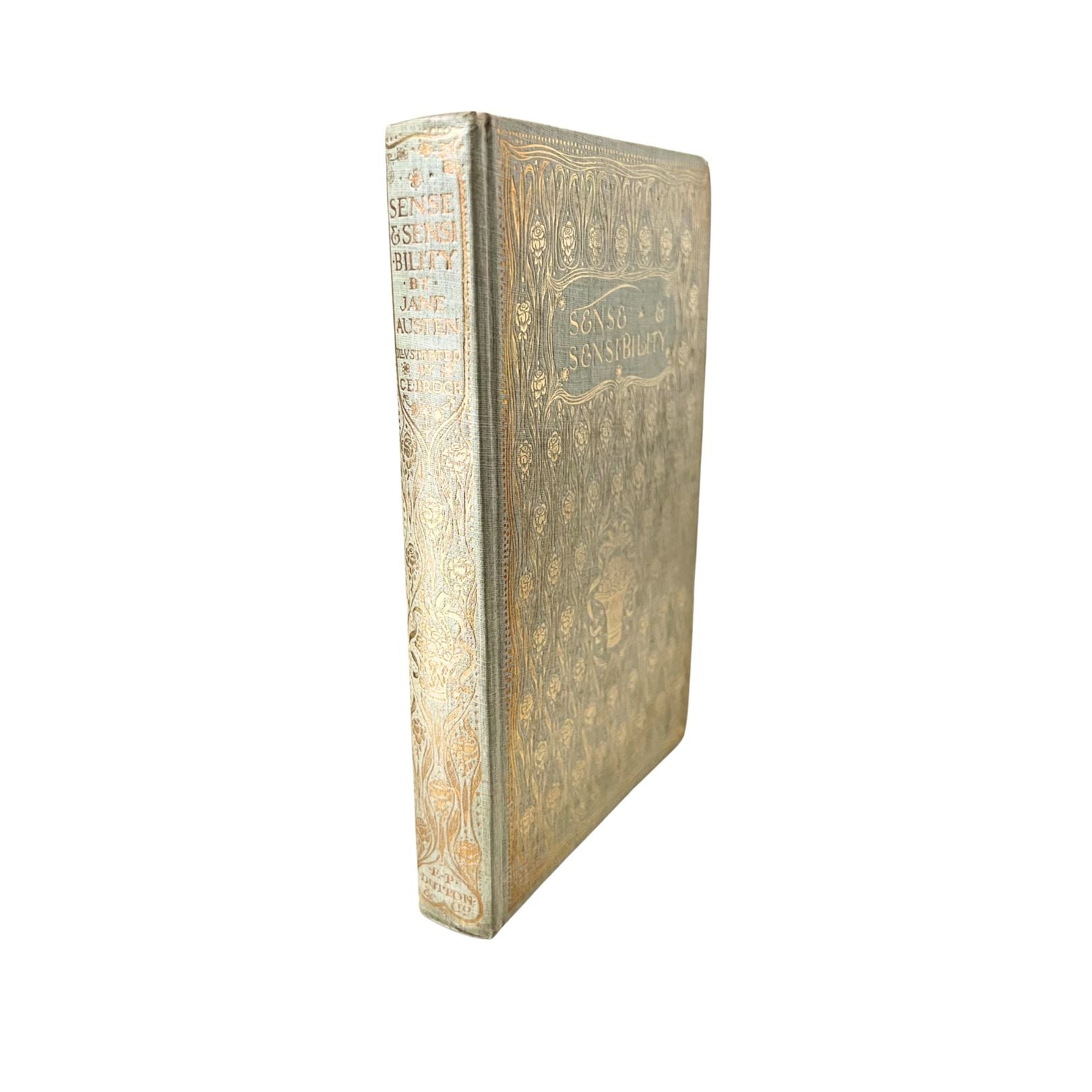
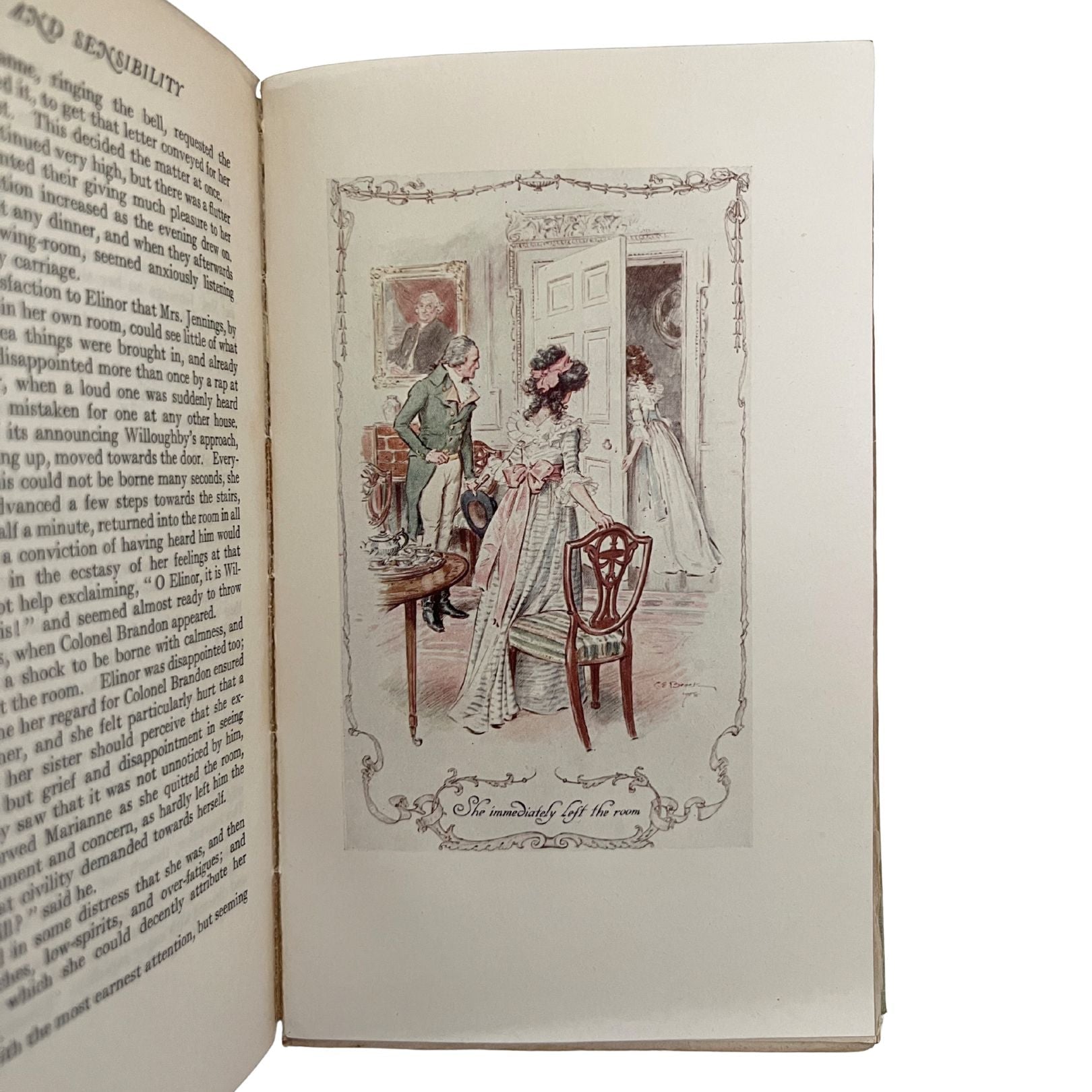
Sense and Sensibility by Jane Austen, Illustrated by C.E. Brock, 1908
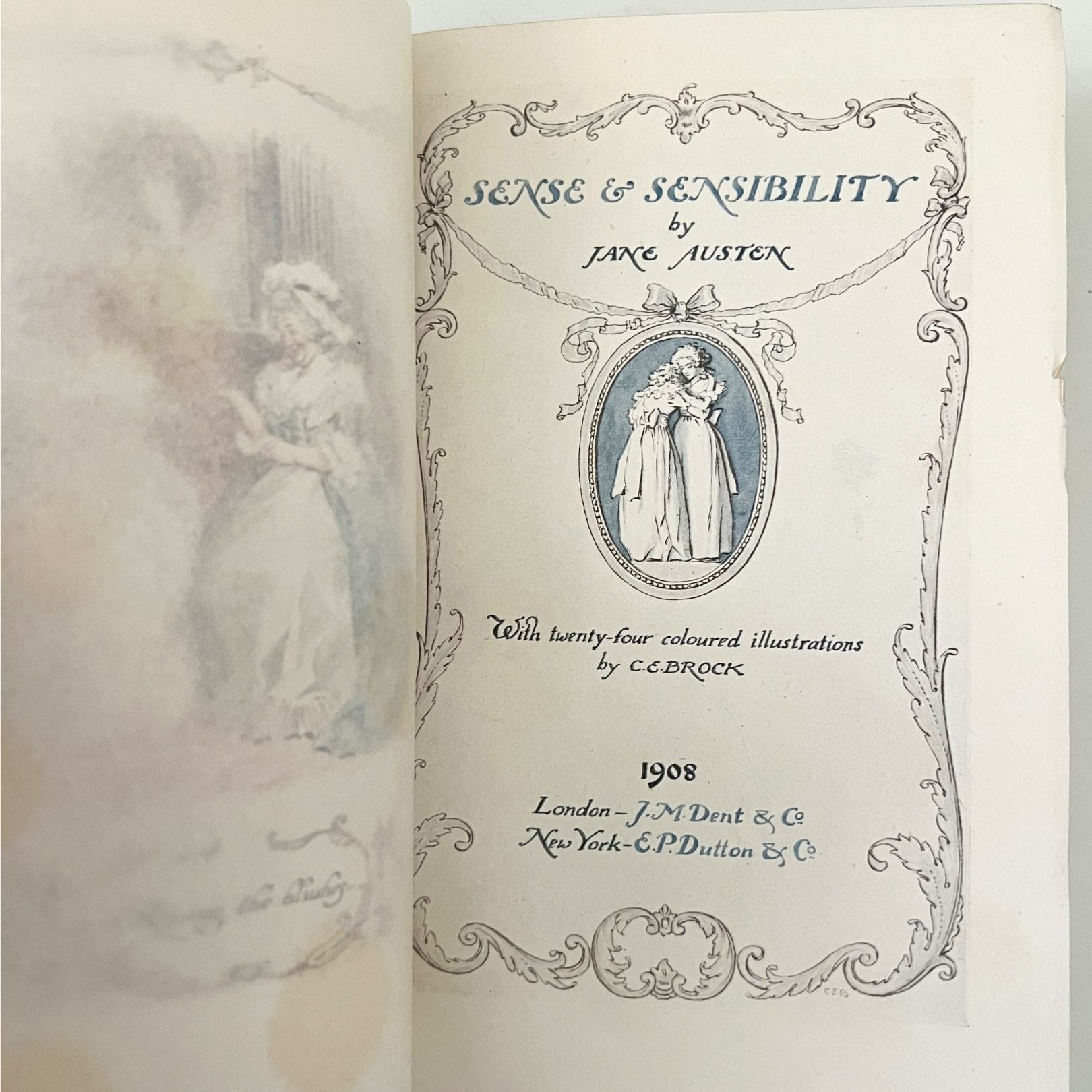
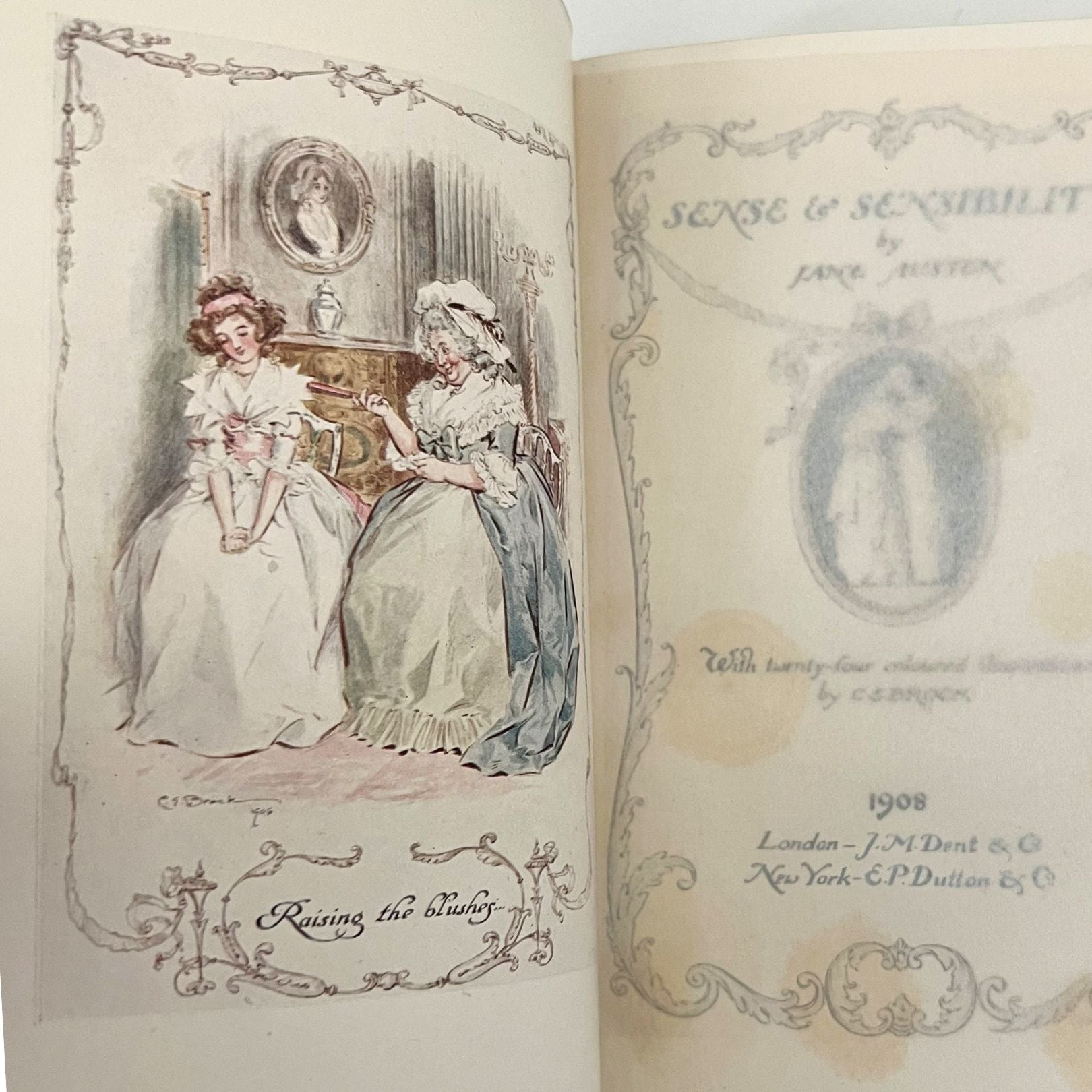
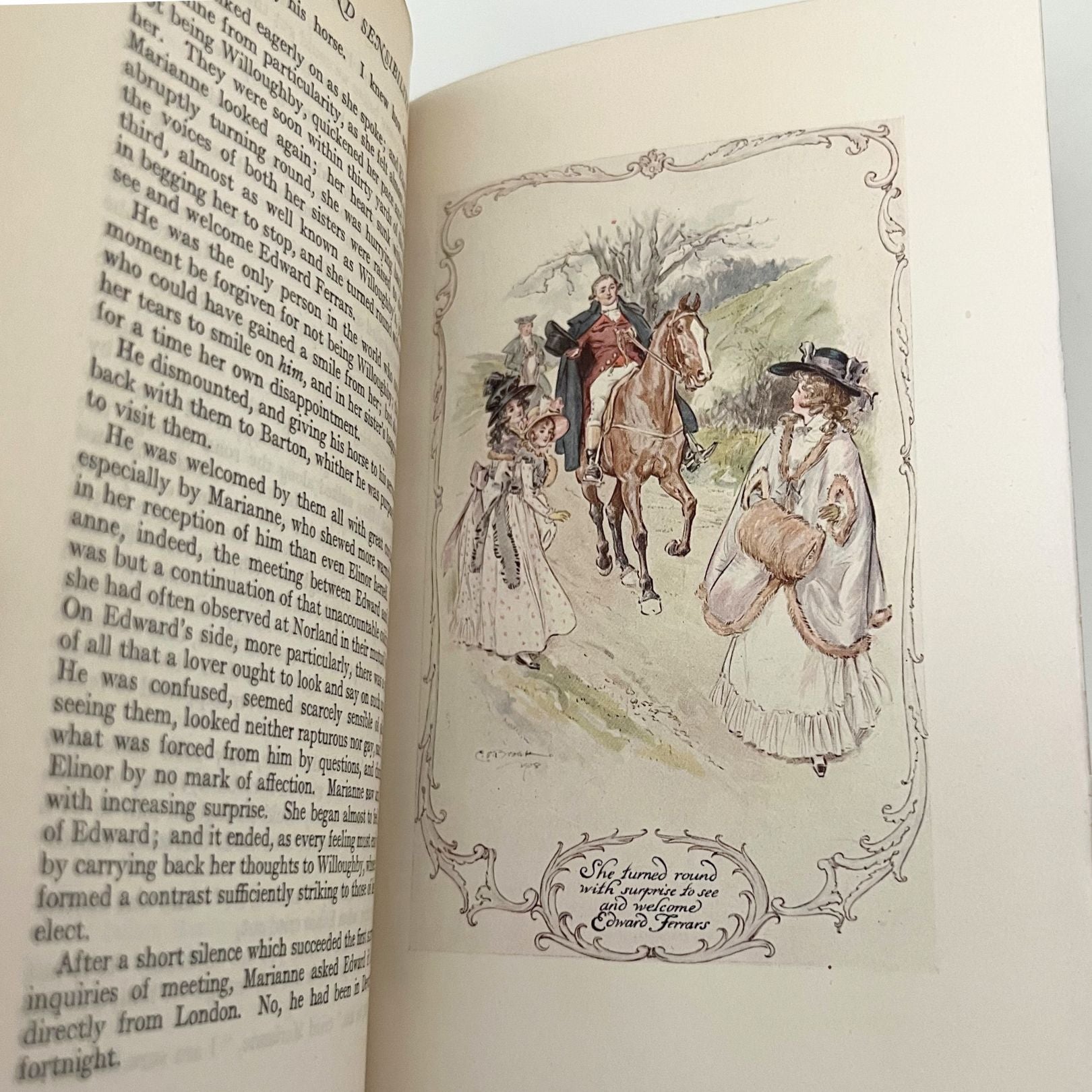
Austen, Jane. Sense and Sensibility. New York and London: E. P. Dutton & Co., J. M. Dent & Co., 1908. The English Idylls Series. Octavo. In original pictorial pale green cloth boards, elaborately stamped in gilt. Illustrated with a tissue-guarded color frontispiece and 24 color plates by Charles E. Brock.
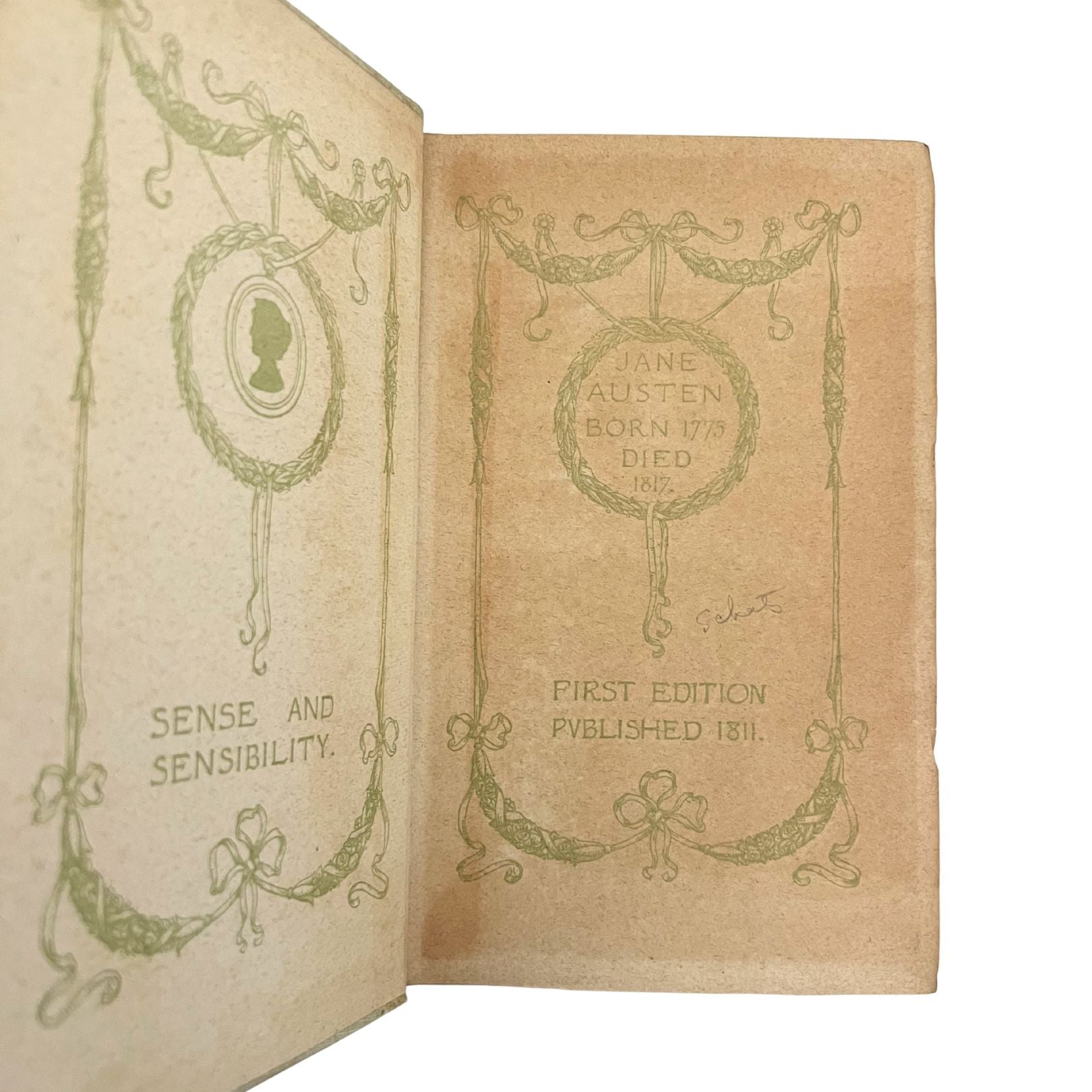
Presented is a beautiful 1908 edition of Sense and Sensibility by Jane Austen. Published simultaneously in both London and New York by J. M. Dent & Co. and E. P. Dutton & Co., this American printing is seen here in the original pictorial pale green cloth boards, ornately stamped in gilt. The book is further embellished with a color frontispiece, decorative title page, and 24 full- color plate illustrations by renowned artist Charles E. Brock. A jewel of a book, this 1908 edition was issued at the height of Austen’s popularity and celebration as part of 19th century literary canon.
Jane Austen (1775-1817) was an English novelist known primarily for her six major novels, which interpret, critique and comment upon the British landed gentry at the end of the 18th century. Austen's plots often explore the dependence of women on marriage in the pursuit of favorable social standing and economic security. Her works critique the novels of sensibility of the second half of the 18th century and are part of the transition to 19th-century literary realism. Austen’s use of biting irony, along with astute social commentary, have earned her acclaim among critics and scholars.
With the publications of Sense and Sensibility (1811), Pride and Prejudice (1813), Mansfield Park (1814), and Emma (1816), Austen achieved success as a published writer. She wrote two additional novels, Northanger Abbey and Persuasion, both published posthumously in 1818. Her six full-length novels were published anonymously and brought her only moderate success and little fame during her lifetime.
After 1818, Austen’s novels remained out of print for 14 years until the publisher Richard Bentley purchased the rights to all six novels from Austen’s publisher T. Egerton and family members Henry and Cassandra Austen. In 1833, Bentley reissued the books as part of his “Standard Novels” series. At the time of the Bentley reissues, Jane Austen was still regarded as a niche writer. Only a few hundred copies of her books were published and reprinted over the years. When Bentley’s copyrights expired, other printers began to publish her works, yet book sales remained modest. It was not until the publication of A Memoir of Jane Austen in 1869, written by her nephew James Edward Austen-Leigh, that interest in Jane Austen was renewed.
Serious literary analysis at the turn of the century also placed Austen firmly within the literary canon, elevating her status to a writer worthy of study and analysis. In an 1870 North British Review, Richard Simpson wrote that Austen, “began by being an ironical critic; she manifested her judgment ... not by direct censure, but by the indirect method of imitating and exaggerating the faults of her models. ... Criticism, humour, irony, the judgment not of one that gives sentence but of the mimic who quizzes while he mocks, are her characteristics.” Twenty years later, Godwin Smith published the Life of Jane Austen, the first formal analysis of Jane Austen’s writing in 1890. In 1892, London publisher J. M. Dent issued the first collected edition of her works to include critical commentary, which resulted in very strong sales.
Following the first color-illustrated production of Austen's works by brothers Charles and Henry Brock in 1898, this 1907 American edition of Sense and Sensibility features more illustrations, expanded and revised by Charles Brock alone. The work was also issued in a deluxe vellum edition, but this is the cloth printing.
British illustrator Charles Edmund Brock (1870-1938) began his illustrative career working for a number of different publishers, including George Routledge & Sons and Walter Scott. But it was as an illustrator for the Cranford series published by Macmillan that he first came to public attention. Charles produced 100 black & white illustrations for an edition of Jonathan Swift’s Gulliver’s Travels in 1894, illustrated Pride & Prejudice by Jane Austin in 1895, and a two-volume Macmillan edition of Charles Kingsley’s Westward Ho! in 1896. At the same time, he was producing illustrations for The Sunday Magazine and Good Words, and was in great demand.
Charles’ career was followed closely by that of his younger brother, Henry Matthew Brock. The two brothers began working for London publisher J. M. Dent in the late 1890s. By 1898, a new printing technique of lithography emerged, which allowed inclusion of illustrations in full color. Dent asked both Charles and Henry to illustrate a ten volume set of Jane Austen novels using this new printing method. The brothers agreed to share the task in equal parts: five volumes each, six illustrations per volume, one as frontispiece. This was the first time the novels by Jane Austen were illustrated in full color and with the high standard of period representation. These "pen and ink drawings tinted in watercolour" gave a more exact and detailed Georgian-era representation than ever before.
Austen historians Laura Carroll and John Wilshire call these Brock-illustrated editions “Chocolate-box” editions, in that they were “gift-book quality, beautiful inside with delicate pen or brush drawings, and outside with gilt embossing and Arts and Crafts inspired design.” Another critic refers to the Brocks’ work as imbued with “delicate teacup and saucer primness.” Although many more illustrators have since contributed with images of the Jane Austen novels, there has never been a more impactful or historically significant illustrator duo than the Brocks. The Brocks introduced color and historically accurate period details to Austen’s characters and their landscapes, breathing life into her fictional characters. Illustrations by the Brocks created "the popular conception or image of 'Jane Austen', a turning point in the history of Jane Austen's cultural reputation," one that was visually repeated by the boom of the 1995 cinema and television adaptations (Carroll and Wiltshire, 2006).
CONDITION:
Very good + condition. Octavo. 308pp. Light green cloth boards with elaborate gilt to front and spine. Top edge gilt, deckle edge. Pictorial endpapers, tissue-guarded color frontispiece and 24 color illustrations by C.E. Brock. This book has E.P. Dutton & Co. in gilt on spine, denoting it as the American printing. Pages lightly toned, some creases and a couple minor page tears. Tissue guard at frontispiece shows staining. Very minor bumping to spine and corners. Toned decorative endpapers. Minor separation of text block and spine.
Book Dimensions: 8” H x 5” W x 1” D.
Accompanied by our company's letter of authenticity.
Pickup currently unavailable at Colorado
Sense and Sensibility by Jane Austen, Illustrated by C.E. Brock, 1908
Colorado
1 Lake Avenue
Colorado Springs CO 80906
United States
Choose options
Frequently Asked Questions
FAQs
Yes, all of our Antiques are certified authentic. Every antique comes with a signed Letter of Authenticity that details the item’s history, its current condition including any conservation, binding, or framing work, and the item’s provenance. The Letters of Authenticity are priced valuations by our authentication specialists, who assure that items are original and unconditionally guaranteed as genuine for life.
We pack and ship your items from our gallery in Colorado Springs. You may also choose to come pick up your order. Antique items are carefully packed and insured during shipping. The shipping price will be calculated at checkout.
We acquire from a variety of trusted sources all over the world, but mostly through auctions and private collections within the United States. All provenance information will be listed on the Letter of
Authenticity accompanying your purchase.