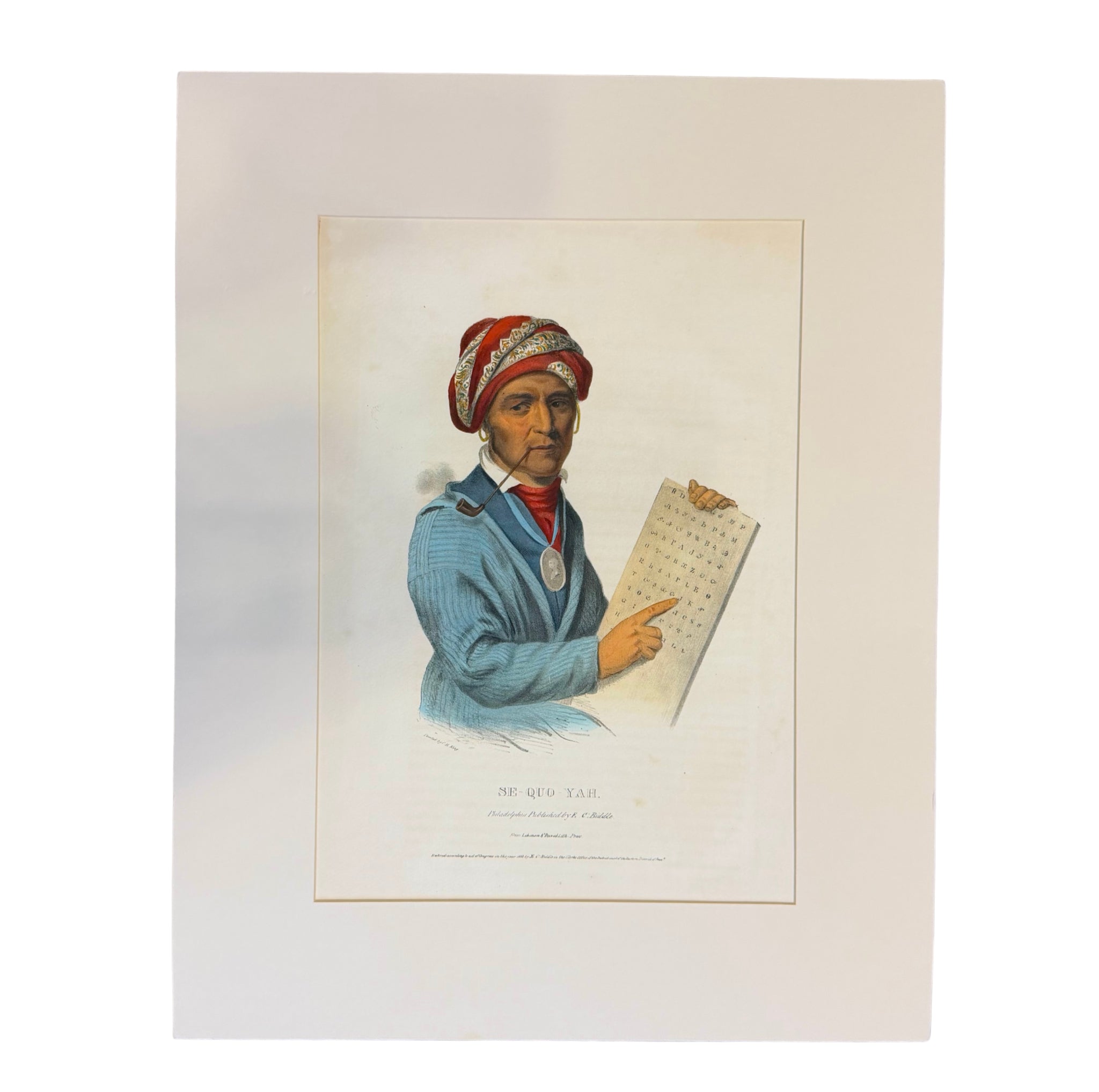
"Se-Quo-Yah" Hand-colored Lithograph by Thomas L. McKenney and James Hall, Folio Edition, 1837
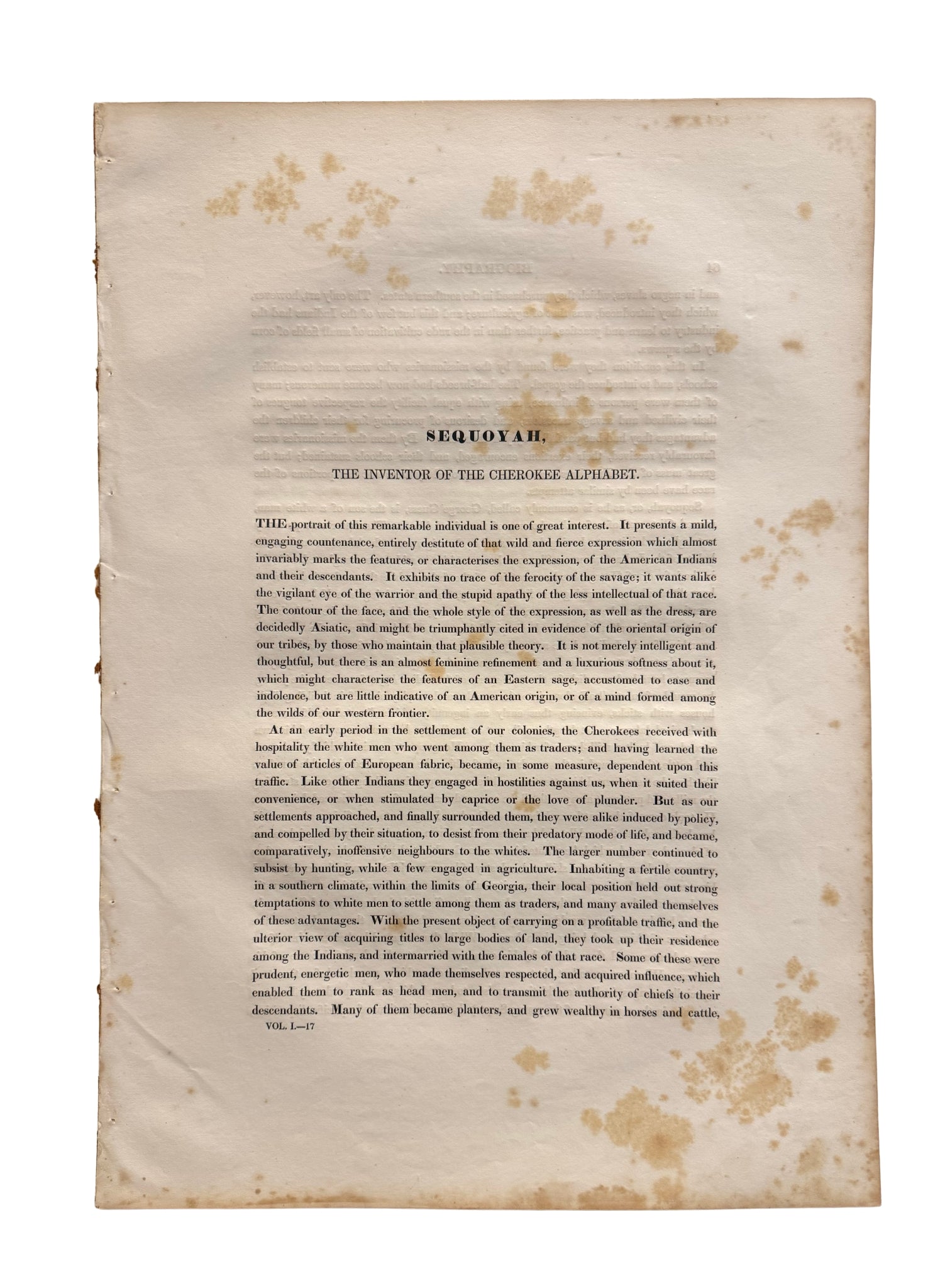
This is a remarkable lithographic portrait of "Se-Quo-Yah," from McKenney and Hall’s three-volume work, Indian Tribes of North America. Se-Quo-Yah was the legendary creator of the Cherokee syllabary. He invented the written form of his spoken language using versions of characters from the Roman alphabet and modifying others to make new symbols. Sequoyah completed his syllabary around 1821. This portrait depicts Se-Quo-Yah wearing a blue striped jacket and a red, white, blue and gold head wrap, with a pipe in his mouth, holding and pointing to his syllabary. The lithographed portrait is after the original painting by Charles Bird King. It was printed by Lehman Duval Lith. Press and published by E. C. Biddle in Philadelphia, in 1837.
Indian Tribes of North America has long been celebrated for its faithful and conscientious portraits of Native Americans. The lithographs in the book are based on paintings by the renowned artist Charles Bird King. The War Department employed King to paint the Indian delegates visiting Washington, forming the basis of the War Department's Indian Gallery. Most of King's original paintings were subsequently destroyed in a fire at the Smithsonian. As such, their appearance in McKenney and Hall's magnificent work is our only record of the likenesses of many of the most prominent nineteenth century Native American leaders.
Thomas McKenney spent six years as the Superintendent of Indian Trade. During his tenure he became increasingly concerned for the survival of the Western tribes. McKenney observed calculating individuals take advantage of the Native Americans for profit and his vocal warnings about their future prompted President Monroe to appoint McKenney to the Office of Indian Affairs. As the first director, McKenney was tasked to improve the administration of Indian programs across various government offices.
In the summer of 1829, McKenney took his first trip to Lake Superior for a treaty with the Chippewa, opening mineral rights on their land. In 1827, he journeyed west again for a treaty with the Chippewa, Menominee, and Winnebago in the present state of Michigan. His journeys provided an unparalleled opportunity to acquaint himself with Native American tribes and leaders. When President Jackson dismissed him from his government post in 1830, McKenney was able to turn more of his attention to his grand publishing project, the Indian Tribes of North America. Within a few years, James Hall, a lawyer who had written extensively about the West, joined him. McKenney and Hall saw their work as a way of preserving an accurate visual record of what they feared was a rapidly disappearing culture. Their epic book was published in three volumes, from 1836 to 1844.
CONDITION:
Near fine condition. Original lithograph, with hand coloring. Paper is healthy and bright, with very light toning and a few small scattered stains. Painted by C.B. King. Printed by Lehman Duval Lith Press. Published by E.C. Biddle in Philadelphia. Entered according to act of Congress in the year 1833 by C.E. Biddle in the Clerks Office of the District court of the Eastern District of Pennsylvania. Lithograph is presented unframed, in a light cream mat, with shrinkwrap.
Matted Dimension: 24” H x 19” W.
REF: AHPCS 7:33b.
Accompanied by our company's letter of authenticity.
Pickup available at Colorado
Usually ready in 4 hours
"Se-Quo-Yah" Hand-colored Lithograph by Thomas L. McKenney and James Hall, Folio Edition, 1837
Colorado
1 Lake Avenue
Colorado Springs CO 80906
United States
Choose options
Frequently Asked Questions
FAQs
Yes, all of our Antiques are certified authentic. Every antique comes with a signed Letter of Authenticity that details the item’s history, its current condition including any conservation, binding, or framing work, and the item’s provenance. The Letters of Authenticity are priced valuations by our authentication specialists, who assure that items are original and unconditionally guaranteed as genuine for life.
We pack and ship your items from our gallery in Colorado Springs. You may also choose to come pick up your order. Antique items are carefully packed and insured during shipping. The shipping price will be calculated at checkout.
We acquire from a variety of trusted sources all over the world, but mostly through auctions and private collections within the United States. All provenance information will be listed on the Letter of
Authenticity accompanying your purchase.