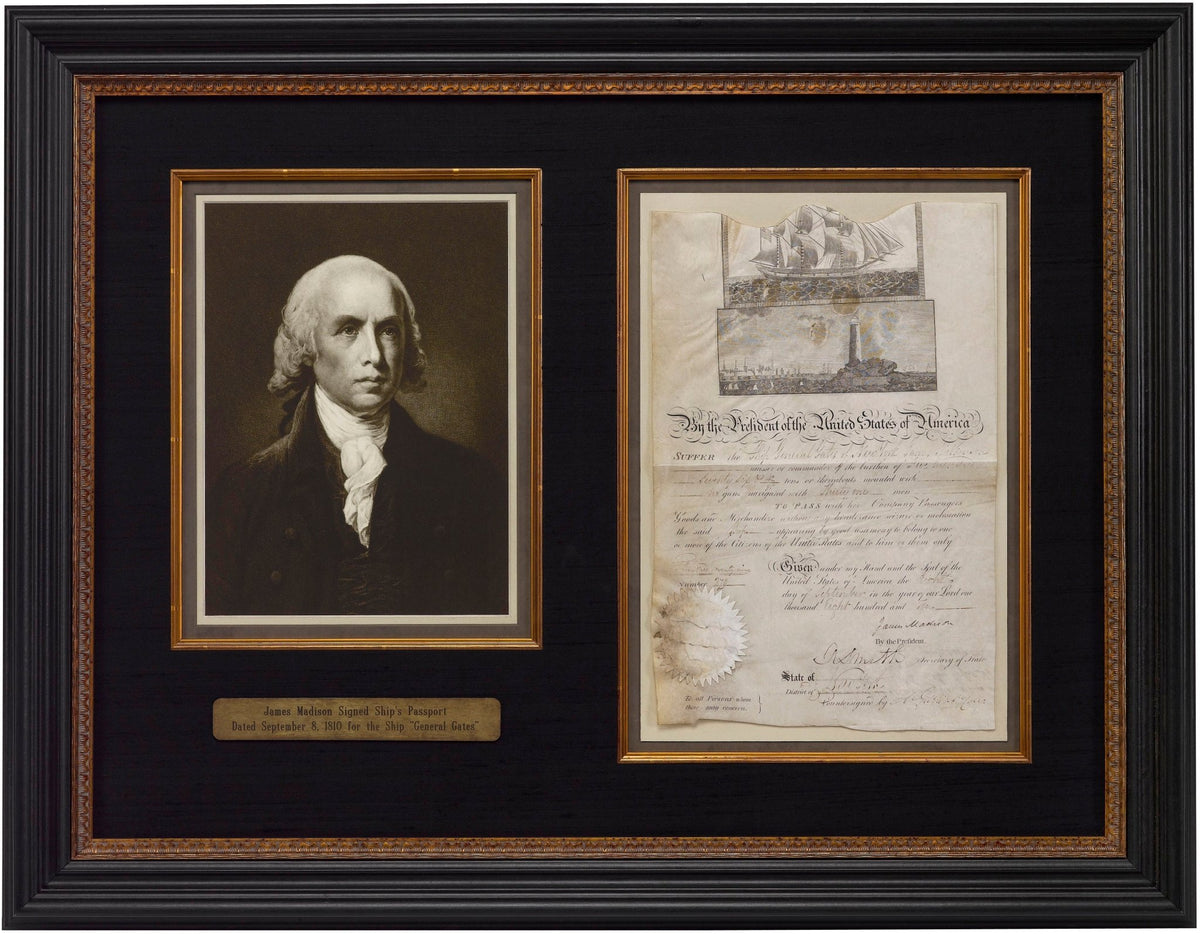
James Madison Signed Scallop Top Ship’s Passport, Dated September 8, 1810
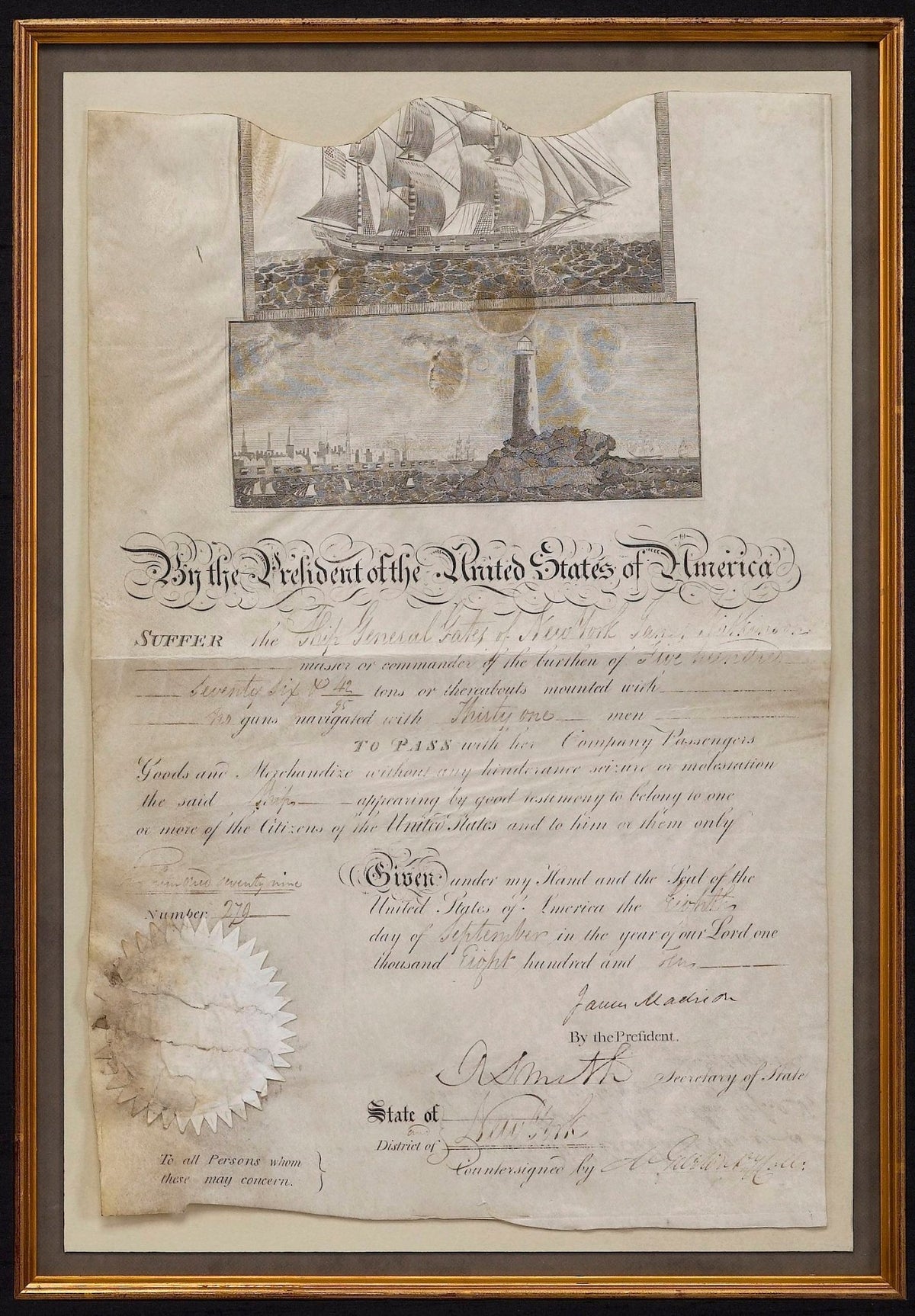
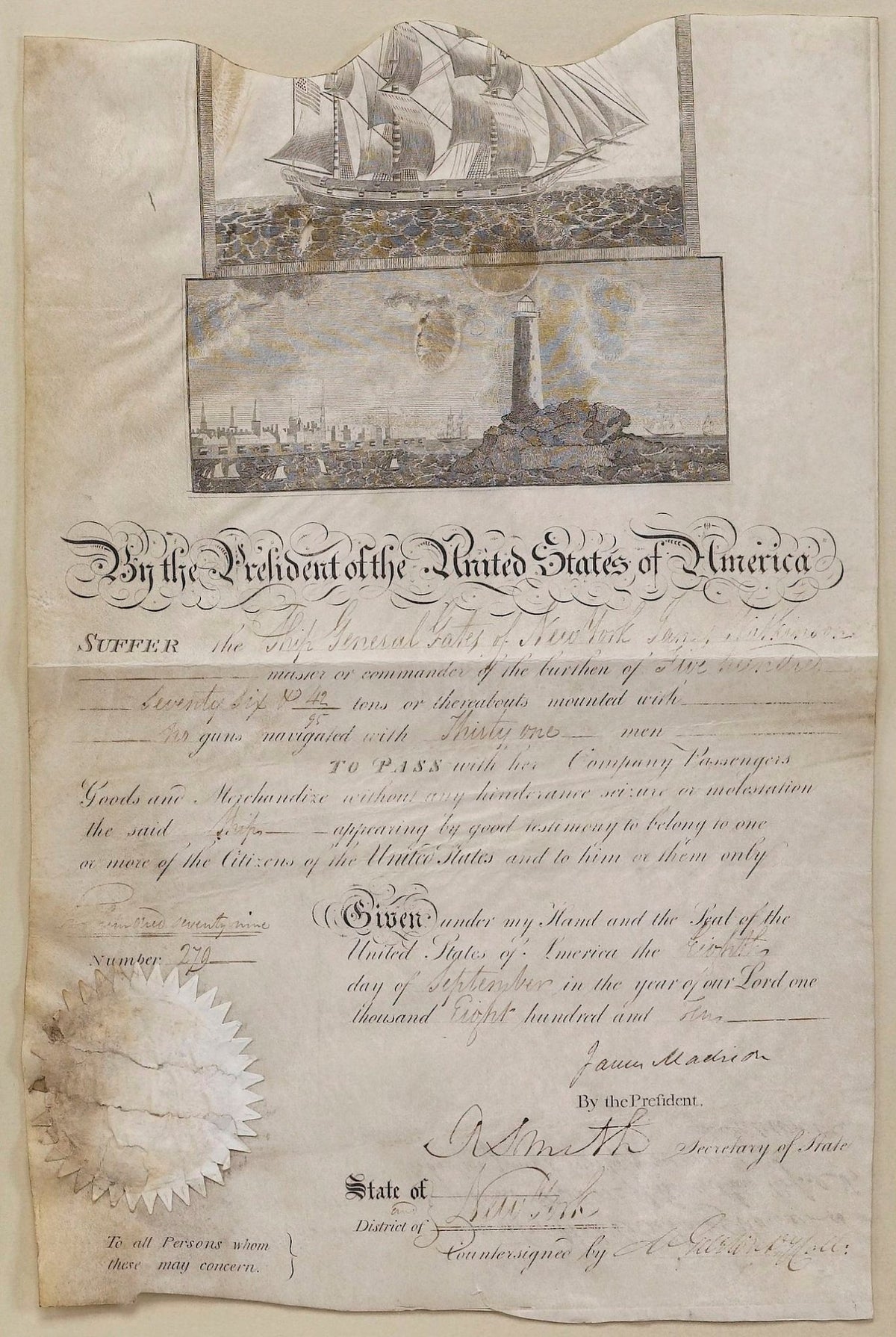
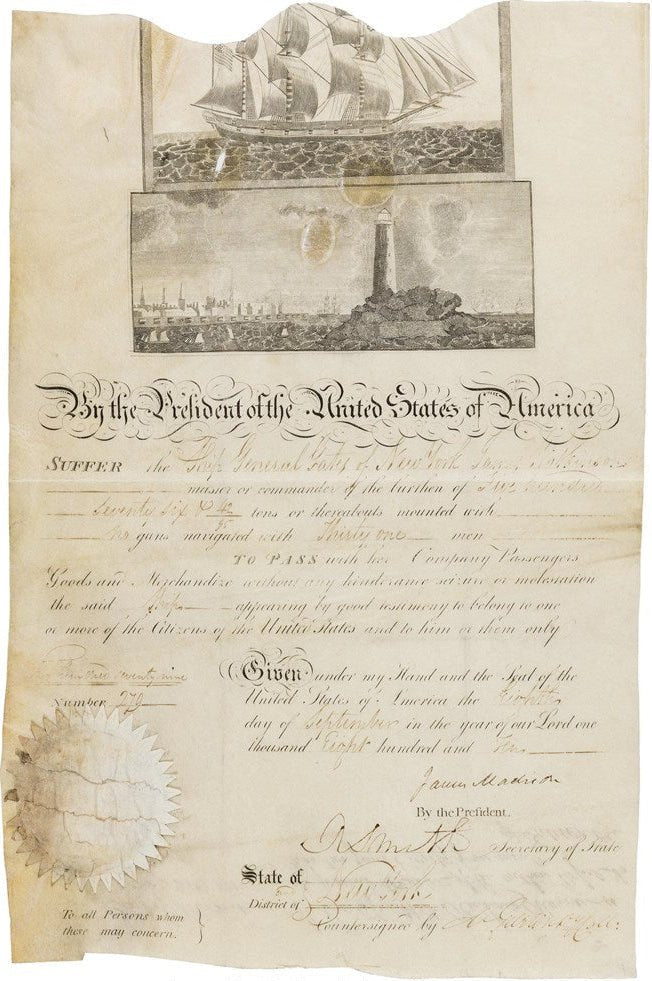
This rare ship’s passport, dated September 8, 1810, is signed by James Madison as President and countersigned by Robert Smith, Secretary of State. The vellum document, partially engraved and finished by hand in ink, consists of the ship's passport for “the Ship General Gates of New York.” This document is a testament to the fragile but expanding position of American maritime commerce in the Mediterranean during the early nineteenth century.
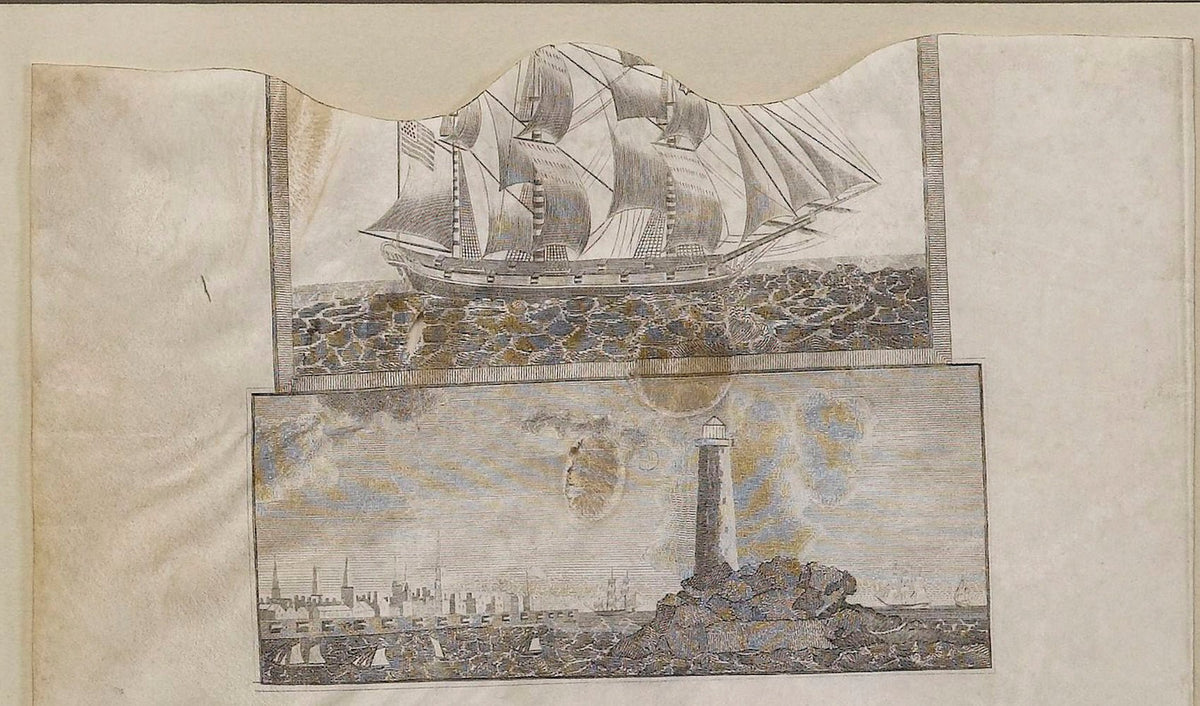
At top is an engraved scene of a schooner and lighthouse harbor scene. The top portion of the document is cut off, with a scalloped edge border. Traditionally, the scalloped top edges of ships’ passports were sent overseas to American consuls stationed in the Mediterranean or other foreign ports. When an American ship arrived, the consul matched the wavy, scalloped top they held with the passport carried by the ship's captain to verify it was genuine.
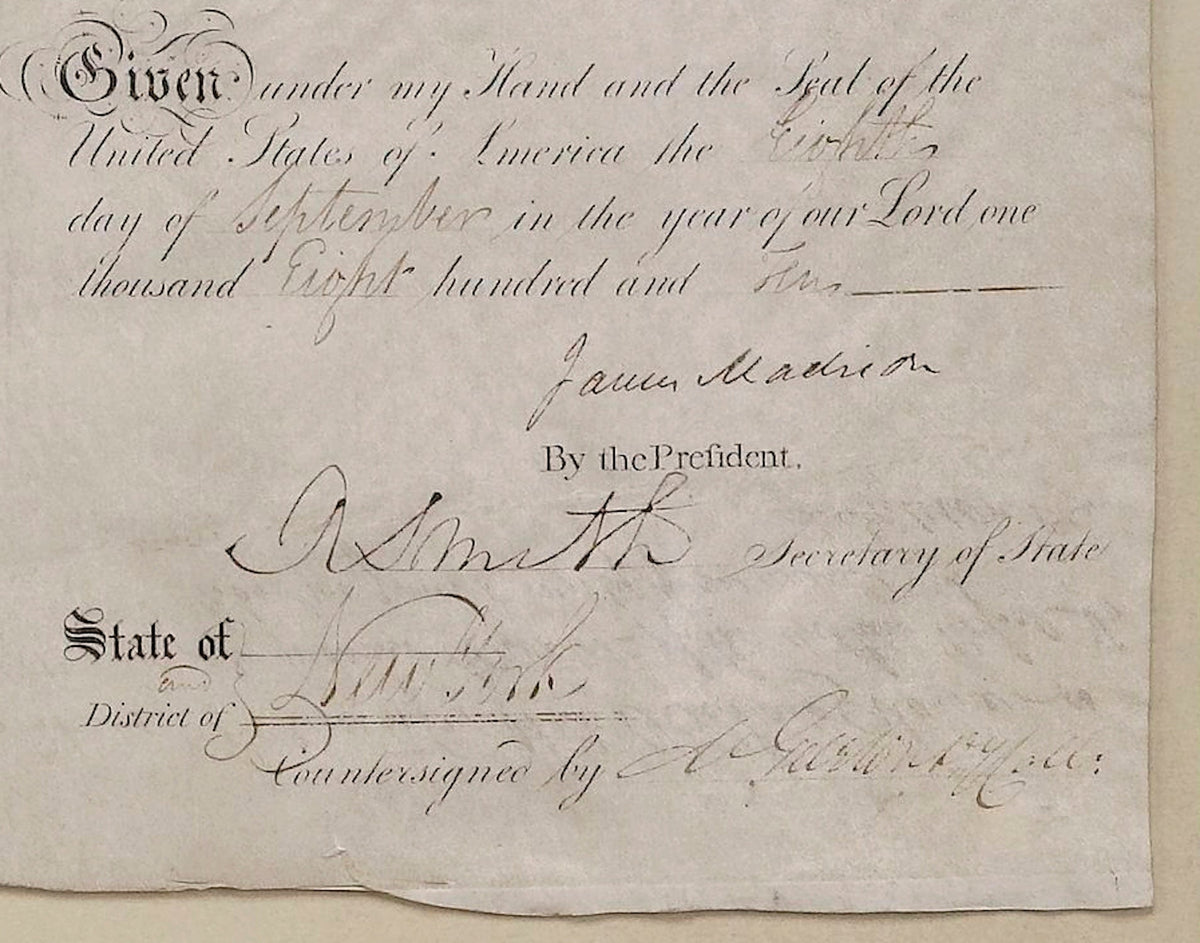
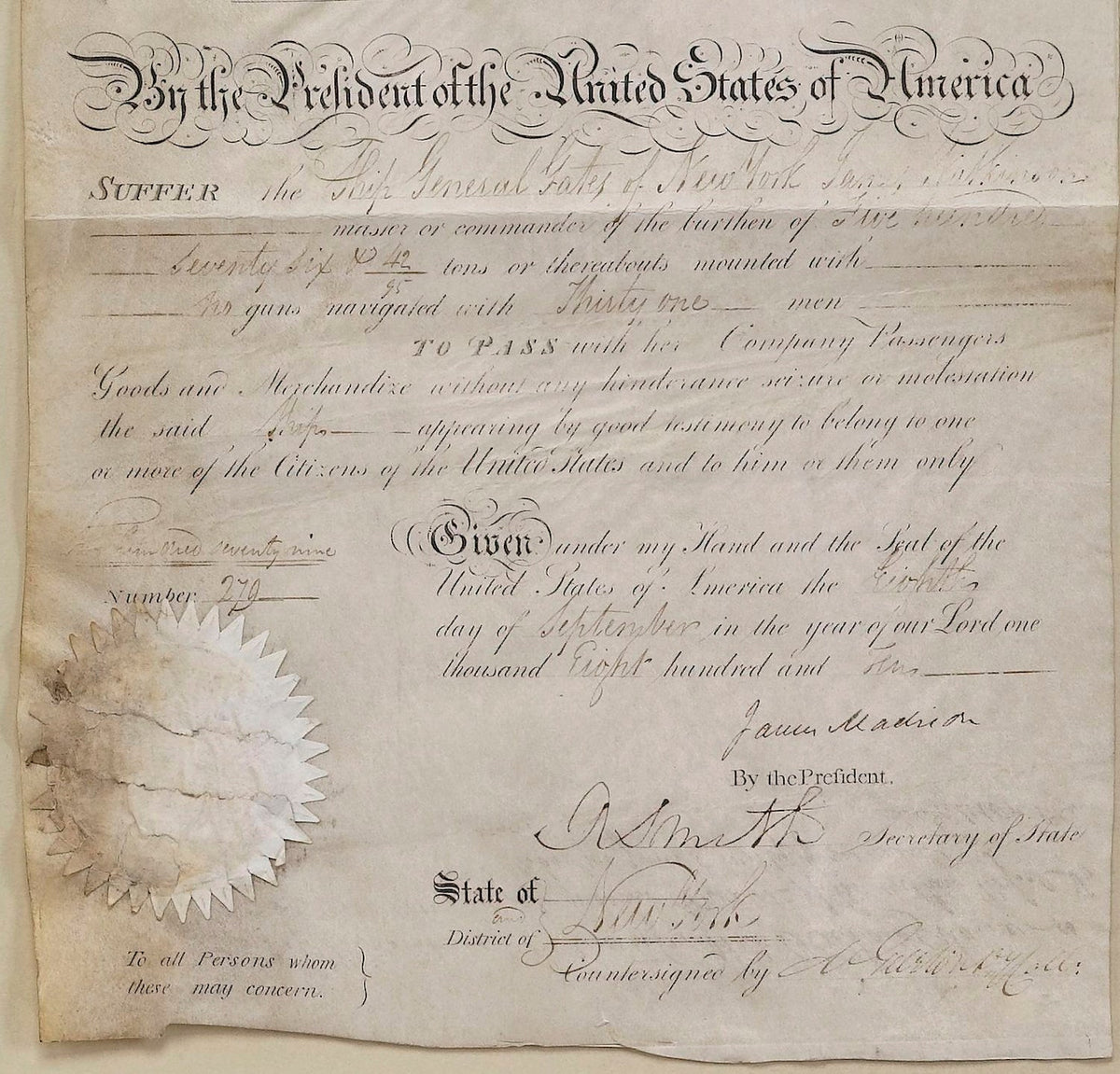
The passport is numbered “279,” issued to the “Ship General Gates of New York,” captained by “James Walkinson” and crewed by thirty-one men. It authorized the ship, which had “the burthen of five hundred, seventy six & 42/95 tons or thereabouts... to pass with her Company, Passengers, Goods, and Merchandize, without any hinderance, seizure of molestation. The said ships appearing by good testimony to belong to one or more of the Citizens of the United States.” The ship's passport is signed “James Madison,” above the signature of his Secretary of State “R. Smith,” and is countersigned by “David Gleston NY Coll,” the New York Collector of Customs. The passport also contains an embossed paper seal affixed at lower left.
Ship’s papers are documents legally required to be carried by an oceangoing vessel, as a certificate of registry, logbook, and cargo manifest. Ship’s papers have occupied a prominent place in the history of maritime law and in treaties of commerce and navigation. Signed presidential authorization such as this, granting the right to sail the high seas and dock in a country's ports, was a valuable privilege. Before conferring such privilege, officials were required to establish the legitimacy of a vessel, its cargo and its personnel, and the ship's papers were intended to authorize its mission. In the wrong hands, especially during the tense and vulnerable conditions of wartime or, as in the perilous years of America's beginnings, when privateers often seized ships and their cargo, a fraudulent or forged approval could be dangerous. Having presidential-signed ship papers stating your neutrality on the open waters helped offset some of the risk involved in the dangerous yet lucrative trade business.
American ship’s passports such as this emerged directly from the political and commercial dangers that followed independence from Great Britain. Before the Revolution, colonial merchants had traded under the protection of the British Royal Navy, but American vessels trading in the Mediterranean lost that safeguard after independence and became vulnerable to seizure by the Barbary states of North Africa, particularly Algiers, Tunis, and Tripoli. Merchant ships sailing into the Mediterranean faced piracy, confiscation of cargo, and the enslavement or ransom of their crews. These mounting threats contributed to the outbreak of the First Barbary War fought during the administration of President Jefferson. The conflict marked the United States’ first sustained naval campaign overseas. Although the war concluded with a treaty, tensions with the Barbary powers were never fully resolved.
By the time this passport was issued in 1810, American commerce remained deeply exposed to political instability throughout both the Atlantic and Mediterranean worlds. The Napoleonic Wars had disrupted international trade through blockades, embargoes, and widespread interference with neutral shipping. British impressment of American sailors and repeated seizures of American vessels pushed the United States steadily toward conflict with Great Britain, while the Barbary rulers again tested American resolve as naval resources became increasingly strained. American merchant captains traveling to Mediterranean ports therefore depended upon official papers such as this passport to establish their national identity and treaty protections abroad. "By providing a statement of American property, signed by the President of the United States … [ship's papers were] intended to confirm our status as a neutral nation, when international conflict put added dangers on America's commerce at sea" (Stein, American Maritime Documents 1776-1860, 113-114).
The document was issued during the uneasy period between the First and Second Barbary Wars, at a moment when American leaders feared renewed aggression from Algiers and other North African powers. Those concerns proved well founded. During the War of 1812, with American naval forces occupied against Britain, the Dey of Algiers resumed attacks upon American shipping and detained American crews, leading ultimately to the Second Barbary War of 1815. This is a one-of-kind item, delving into the early American history of maritime law and our trade network with the Mediterranean during our nascent years as a country.
CONDITION:
Very good + condition. Vellum. Partially printed, partially inscribed. Cut top edge, with a bit of the original printed line visible. Engraving at top of ship and lighthouse scene. Some staining, specifically two approx. 1” round (water) stains at engravings. ¾ ” slit at bottom of ship engraving, approx. ¾” tear along stain on lighthouse engraving. Light toning specifically at the left side of the document. The seal at bottom left shows some heavy creasing and staining, a few losses at the outer left side. Horizontal center crease, light creasing along edges. Uneven cut at bottom. Overall still very bright. Ink is bold, specifically Madison’s signature. Docketed on verso. Verso reads: Ship General Gates, 576 42/95 tons. Port of New York } Dec 21st 1811. I certify that Richard Marne(?) is at present Master of the within vessel & has two guns + forty five men. D. Gleston. Unframed Dimensions: 15” H x 10” W.
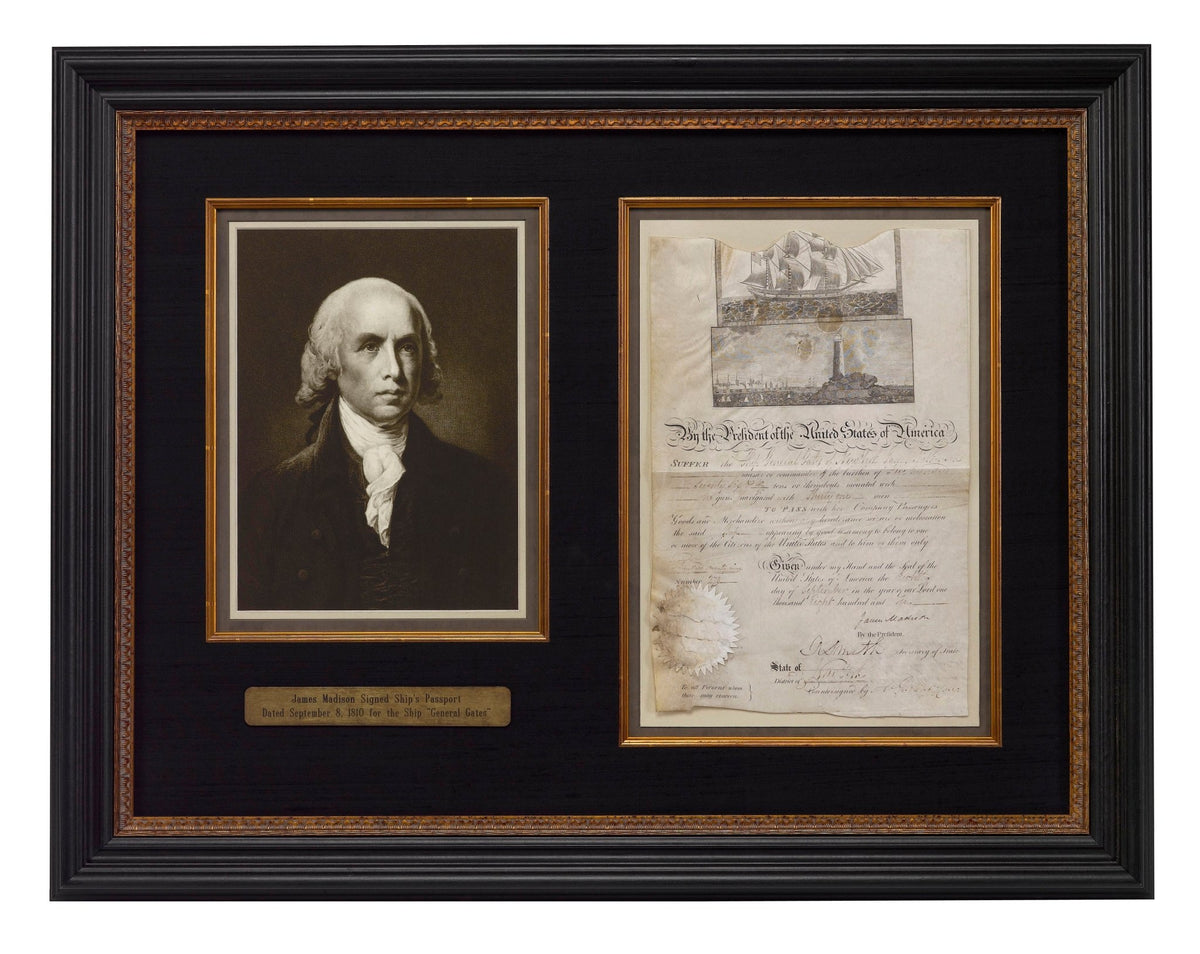
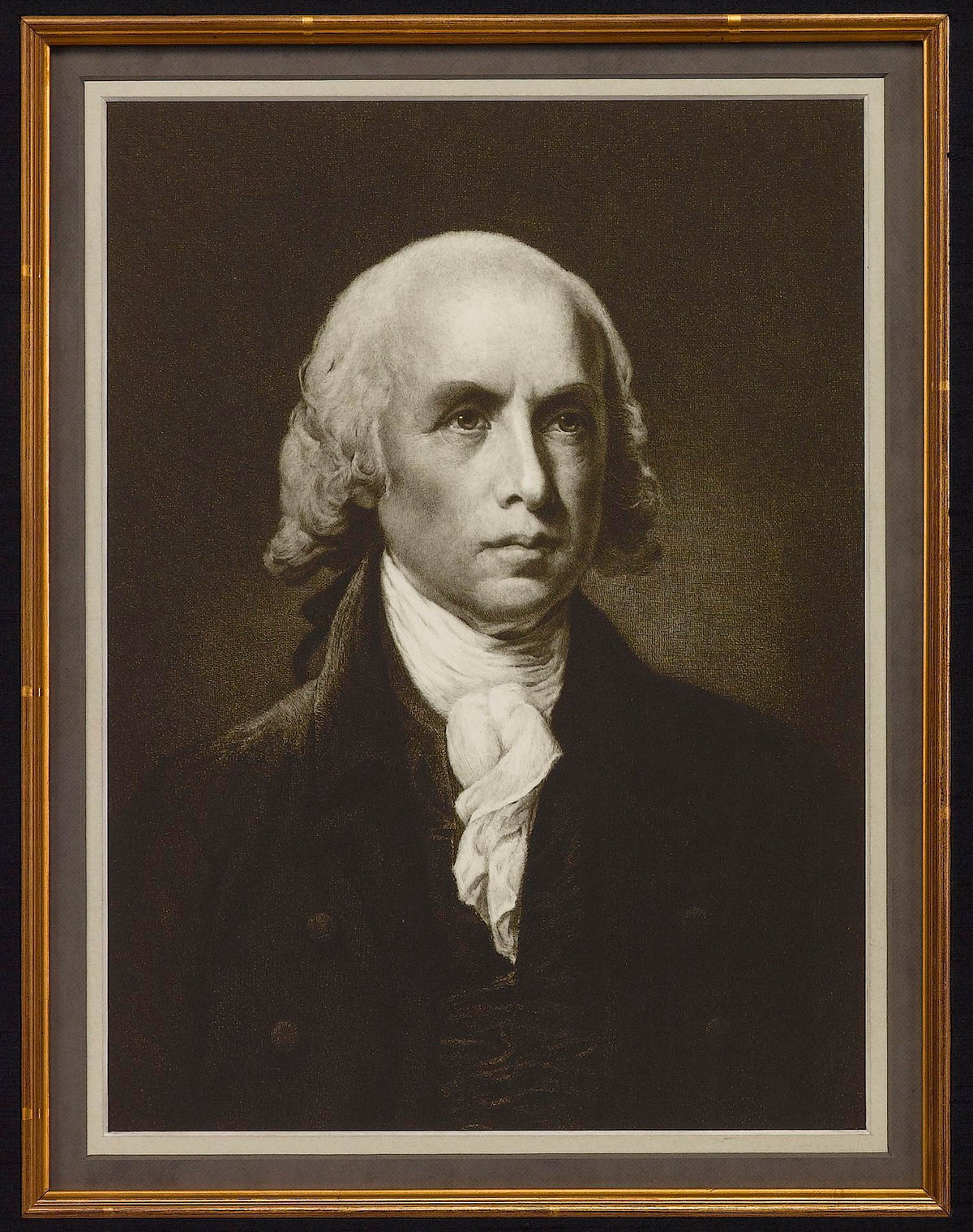
Archivally framed to archival standards with a printed portrait of Madison, with custom acid-free mats, gold spandrel, UV Glass, and a custom-built wooden frame with metal plaque.
Framed Dimensions: 27 1/4"H x 35 5/8"W x 1 5/8"D".
Accompanied by our company's letter of authenticity.
Pickup available at Colorado
Usually ready in 4 hours
James Madison Signed Scallop Top Ship’s Passport, Dated September 8, 1810
Colorado
1 Lake Avenue
Colorado Springs CO 80906
United States
Choose options
Frequently Asked Questions
FAQs
Yes, all of our Antiques are certified authentic. Every antique comes with a signed Letter of Authenticity that details the item’s history, its current condition including any conservation, binding, or framing work, and the item’s provenance. The Letters of Authenticity are priced valuations by our authentication specialists, who assure that items are original and unconditionally guaranteed as genuine for life.
We pack and ship your items from our gallery in Colorado Springs. You may also choose to come pick up your order. Antique items are carefully packed and insured during shipping. The shipping price will be calculated at checkout.
We acquire from a variety of trusted sources all over the world, but mostly through auctions and private collections within the United States. All provenance information will be listed on the Letter of
Authenticity accompanying your purchase.