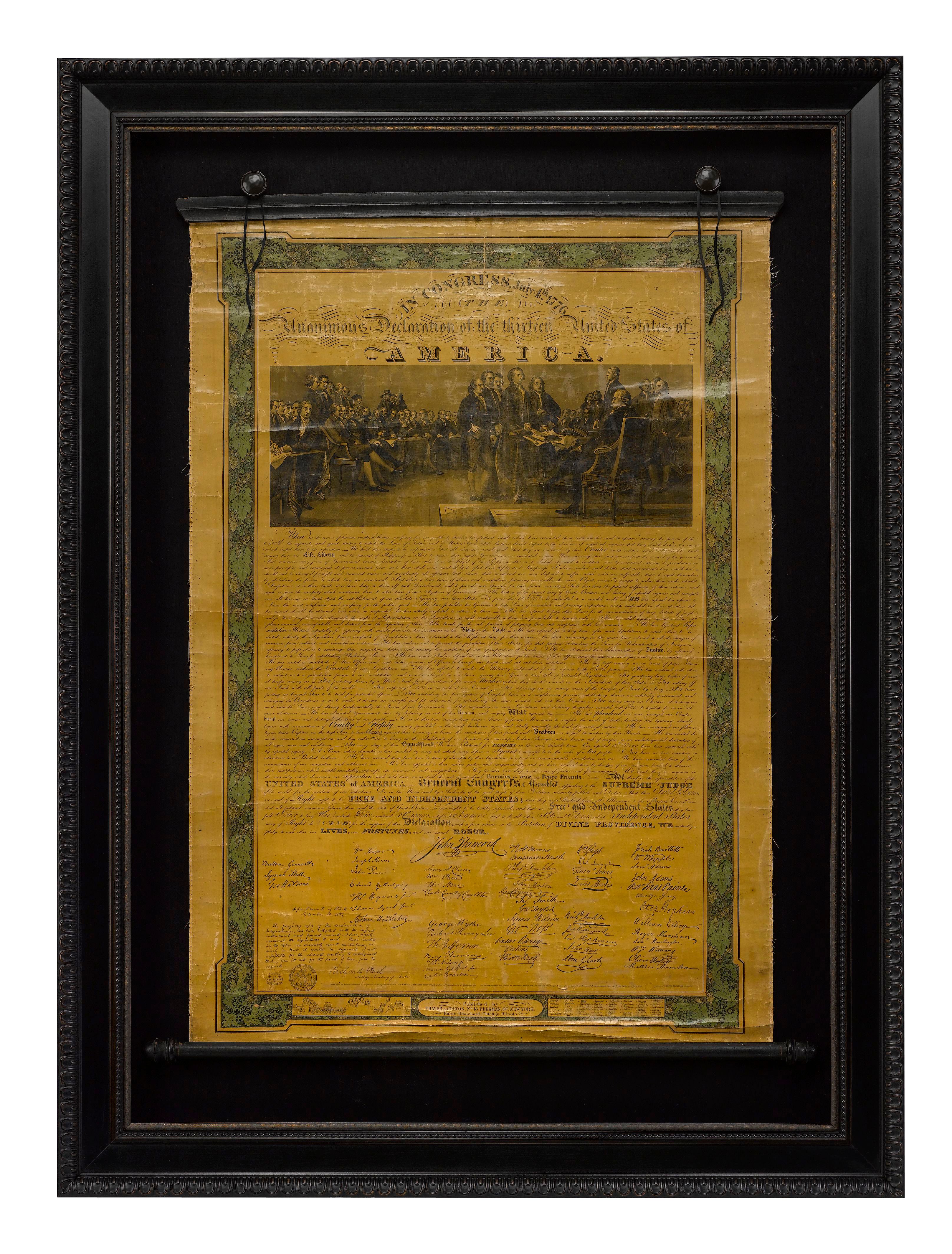
Declaration of Independence Broadside, Published by Thayer & Colton, Printed by Lang & Laing, c. 1860
Presented is a rare 1860s broadside printing of the Declaration of Independence, attached on its original wooden rollers. The broadside was published by Thayer & Colton and printed by Lang & Laing in New York in the 1860s. A later adaptation of Benjamin Owen Tyler's famous 1818 Declaration broadside, this printing has an added pictorial engraving of Trumbull's 1820 oil painting of “The Declaration of Independence of the United States of America, July 4th, 1776,” inset at the top, with an informational key to Trumbull's painting in the bottom border. The whole is surrounded by a green border of grape vines and clusters.
The Declaration text on this broadside closely mimics the 1818 broadside by Benjamin Owen Tyler. Tyler’s engraving of the Declaration was the first decorative print with facsimiles of the signatures based on the original manuscript. Although rigorously exact in his signature facsimiles, Tyler made no effort to match the handwriting in the body of the Declaration. Rather, Tyler used the text as an opportunity to showcase his craft, with selected key words and phrases, such as “life,” “liberty,” “free and independent states,” and “rights of the people,” emphasized with artfully ornamental script. As noted by the publishers of this 1860 printing, the text was “Copied from the Declaration of Independence in the Department of State and Published by Benjamin Owen Tyler, Professor of Penmanship, City of Washington, 1818” and continues, “The publisher designed and executed the ornamental writing, and has been particular to copy the Facsimiles Exact, and has also observed the same punctuation, and copied every Capital as in the original.”
The Declaration of Independence is the foundational document of the United States and has been printed many times since its original publication in 1776. First published as broadsides, then as an essential addition to any volume of laws, it is a basic work in the American canon.
Following the War of 1812, Americans began to look back on the era of the founding of the country, for the first time with historical perspective. The republic was now forty years old and the generation of the American Revolution, including the signers of the Declaration, was looking for a way to record all it had accomplished and witnessed. With nostalgia and curiosity, many Americans began to examine the details of the nation’s founding. Documents like the debates of the Constitutional Convention, first laws of the United States, and the Declaration were published for the first time.
It seems extraordinary that the Declaration of Independence, as created, was unknown to Americans, as the text is so central to the national ego. Yet besides traveling exhibits of the original document, many Americans had not seen or read the text. Several entrepreneurs set out to bridge this gap by printing broadsides of the document. The first to publish a Declaration broadside was a writing master named Benjamin Owen Tyler, who created a calligraphic version of the Declaration and published it in 1818, recreating exactly the signatures of the signers as they appeared on the original. Another early engraver to work on a Declaration project was Philadelphia newspaper publisher John Binns. As early as June 1816, “Binns began a list of subscriptions for his publication of ‘a splendid and correct copy of the Declaration of Independence, with facsimiles of all the signatures, the whole to be encircled with the arms of the thirteen States and of the United States.’”
In the following years, many publishers took up the mantle, issuing their own versions of the Declaration. While some aimed to honor the design of the original document, others added extra ornamentation, like intricate allegorical and patriotic borders, inset illustrations of founding fathers and early American Presidents, important American cities or landmarks, state seals, and scenes of the nation’s technological or agricultural advancement since its founding. This example, published in the 1860s, follows in that same tradition.
CONDITION:
In very good condition. Engraved broadside, large folio. With original hand-coloring. Normal age toning, crackling and creasing in some areas, a couple small areas of wear, with small puncture, minor loss. Wear to the edges. Small archival patch on back towards top edge to support small separation. Canvas backed. Green hand-coloring is partially faded, paper with light to moderate toning. Attached to wooden scrolls at each end.
Publisher’s line reads: "Copied from the Declaration of Independence in the Department of State and Published by Benjamin Owen Tyler, Professor of Penmanship, City of Washington, 1818" and then "The publisher designed and executed the ornamental writing, and has been particular to copy the Facsimiles Exact, and has also observed the same punctuation, and copied every Capital as in the original." and then on the far right hand : "Engraved by Peter Maverick, Newark, N. J." Lower left shows "Printed by Lang & Laing, 117 Fulton St. N.Y." Bottom border has “Published by Thayer & Colton, No. 16 Beekman St, New York. Rufus Blanchard, Chicago, Illinois." printed at center, flanked on both sides by the numbered key to Trumball’s painting.
The engraving has been beautifully framed to archival conservation standards in a custom-built black and gold wooden frame, with gold spandrels, a black linen top mat, and UV plexiglas.
Accompanied by our company's letter of authenticity.
Pickup available at Colorado
Usually ready in 4 hours
Declaration of Independence Broadside, Published by Thayer & Colton, Printed by Lang & Laing, c. 1860
Colorado
1 Lake Avenue
Colorado Springs CO 80906
United States
Choose options
Frequently Asked Questions
FAQs
Yes, all of our Antiques are certified authentic. Every antique comes with a signed Letter of Authenticity that details the item’s history, its current condition including any conservation, binding, or framing work, and the item’s provenance. The Letters of Authenticity are priced valuations by our authentication specialists, who assure that items are original and unconditionally guaranteed as genuine for life.
We pack and ship your items from our gallery in Colorado Springs. You may also choose to come pick up your order. Antique items are carefully packed and insured during shipping. The shipping price will be calculated at checkout.
We acquire from a variety of trusted sources all over the world, but mostly through auctions and private collections within the United States. All provenance information will be listed on the Letter of
Authenticity accompanying your purchase.