

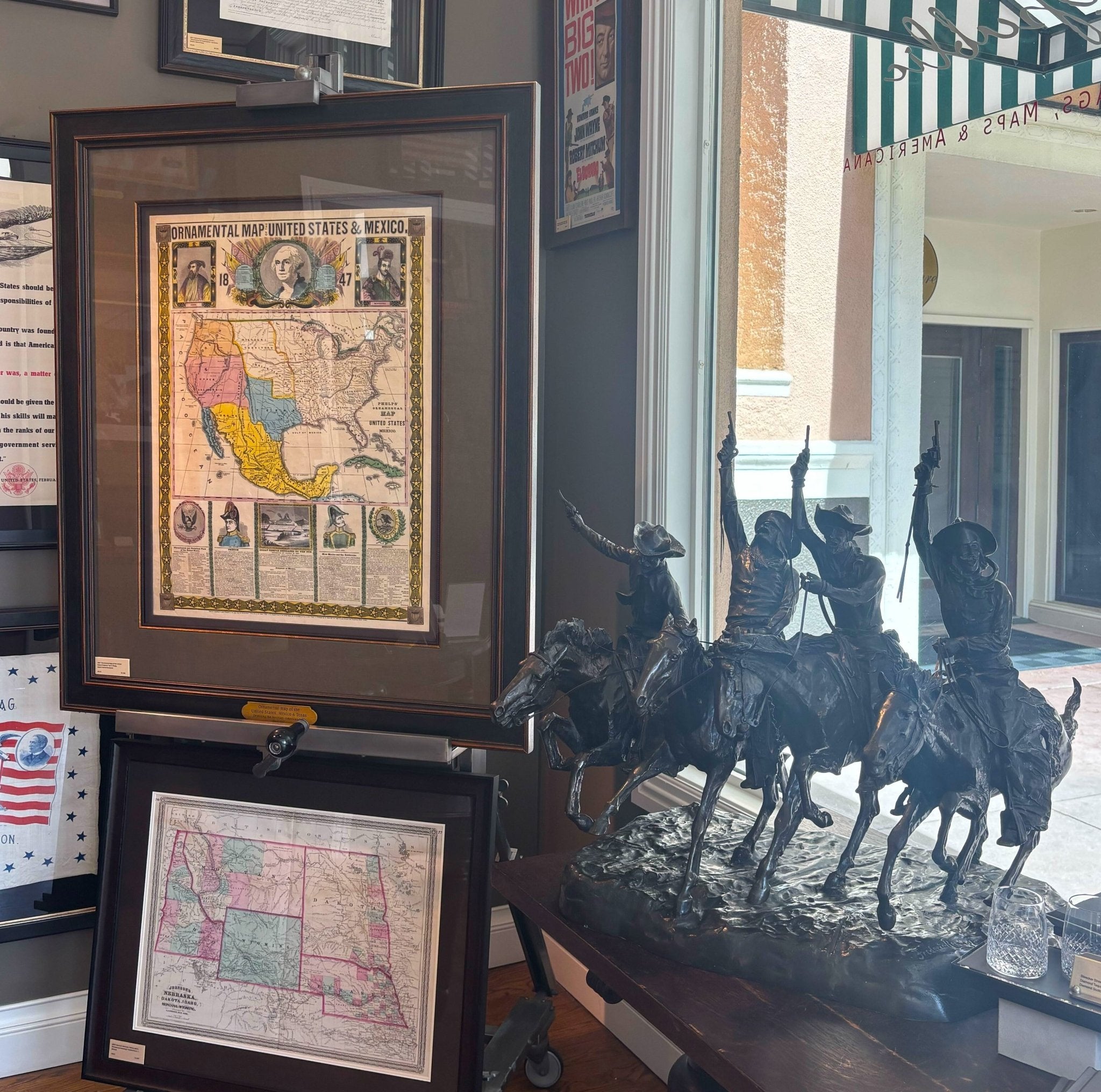
"Coming Through the Rye" Bronze Sculpture, after Frederic Remington
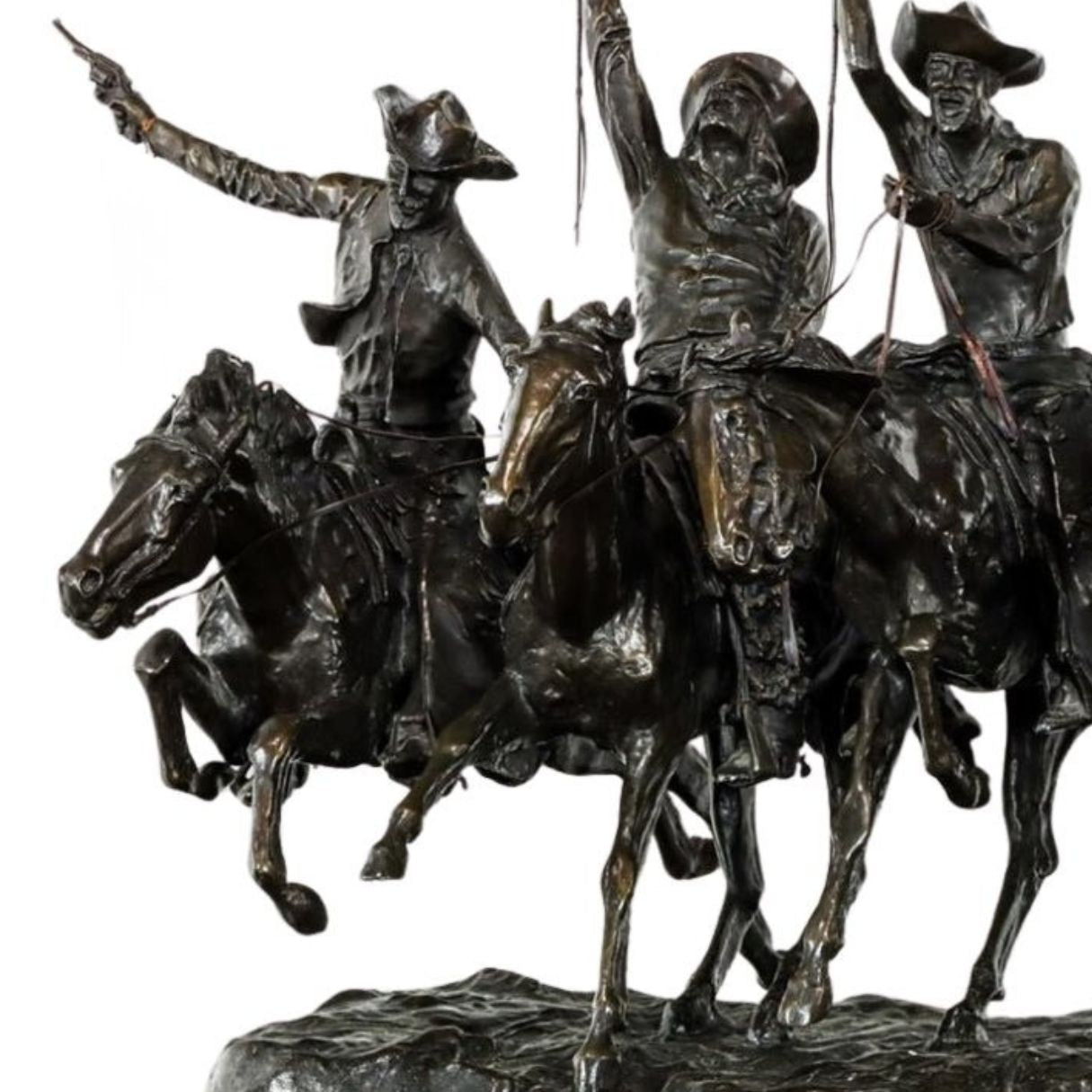
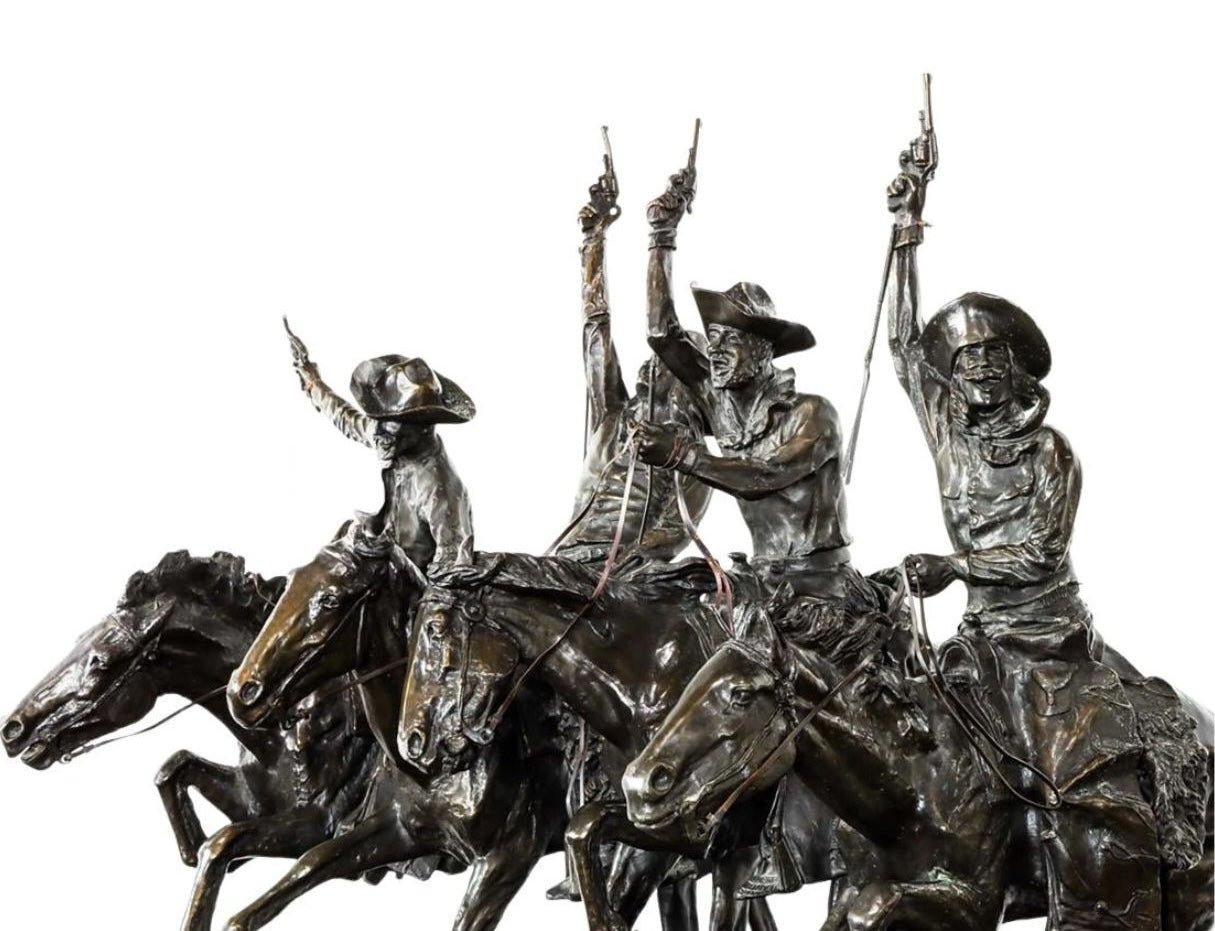
Presented is a bronze sculpture, entitled "Coming Through the Rye," after renowned Western artist Frederic Remington. The large bronze depicts four mounted and galloping cowboys, with their pistols raised in the air. Cast using the lost-wax process, this is a later reproduction of one of only twenty two bronze sculptures Remington created during his life.
"Coming Through the Rye" is one of Frederic Remington's most ambitious bronze sculptures. It was initially conceived in 1902, inspired by the artist's own illustrations, The Dissolute Cow-Punchers, published in Century Magazine in October 1888, and Cowboys Coming to Town for Christmas, published in Harper’s Weekly in December 1889. The technical challenge of creating a sculpture in which only six of the sixteen horse feet touch the ground excited Remington and Riccardo Bertelli, the founder of Roman Bronze Works, as they experimented and pushed the technical limits of bronze casting. Working from 1902 to 1908, there were only 15 numbered versions and 2 unnumbered prototypes of this bronze created.
The jubilant and frenetic energy captured in the work was well received by art critics and historians. “Here are four cowboys, wild, harum-scarum devils, shooting up a town from the mere joy of a healthy existence, plus the exhilaration produced by frontier rum! They are dashing down the street, the ponies at top speed, spurning the group beneath their feet – and that is the marvelous part of it – only five of those pattering hoofs touch the earth, and there are eight pairs of them!” (Barnes). The cowboys “have the spark of abandon and deviltry in their hollow eyes; and their mouths are open as though in the act of shrieking out some wild Western apostrophe to the red gods of recklessness. The broncos, snorting and straining forward, are shoulder to shoulder, and their flying hooves emphasize the devil-may-care of such a mad ride" (McCracken). Thanks to its technical skill and energetic and dynamic sculpting, "Coming Through the Rye" has become “etched into popular consciousness in a way that is rare in the annals of American sculpture” (Shapiro, Hassrick).
Although born, raised, and educated on the East Coast, Frederic Remington (1861-1909) achieved considerable success as America’s leading illustrator of life on the western frontier. His career took off in the mid-1880s when he began making western illustrations for Harper's Weekly and many other widely read New York magazines. Accompanying both factual news reports and colorful fictional tales, Remington's pictures delighted and informed an East Coast populace hungry for information of the new frontier. Remington traveled West repeatedly and greatly admired the rough and intrepid cowboys and soldiers he met there. He enjoyed meeting them and hearing their stories during his visits as a journalist and illustrator.
Remington produced over 3,000 signed works. Most of them were illustrations, but as he grew older, he turned away from the publishing world and accomplished masterful paintings and drawings. From 1895 to his passing, Remington turned to sculpture and impressionistic oil-on-canvases. He created 22 stunning, energetic bronzes, most of which were created using both sand-casting and the lost-wax method of casting.
The first foundry with which Remington worked was the Henry-Bonnard Bronze Company in New York. Four different sculptures were cast in bronze, starting in 1895, using the sand-casting method. They were "The Broncho Buster," "The Wounded Bunkie," "The Wicked Pony," and "The Scalp." Starting in 1900, Remington began working exclusively with the Roman Bronze Works, in New York. Using the lost-wax bronze casting process, they produced the rest of his bronzes until his death in 1909.
Some of Remington’s bronzes were inspired by motifs developed in his paintings and illustrations; others were innovative and complex multi-figure compositions. His talent for sculpture was matched by his technical prowess and exploration, notably seen in his textural detail and innovative patination. Remington’s bronzes have a profound sense of storytelling, resulting in some of the finest American bronzes of the time. Unlike most of his fellow sculptors, Remington rarely worked on a monumental scale. His only known large-scale sculpture is "The Cowboy."
CONDITION:
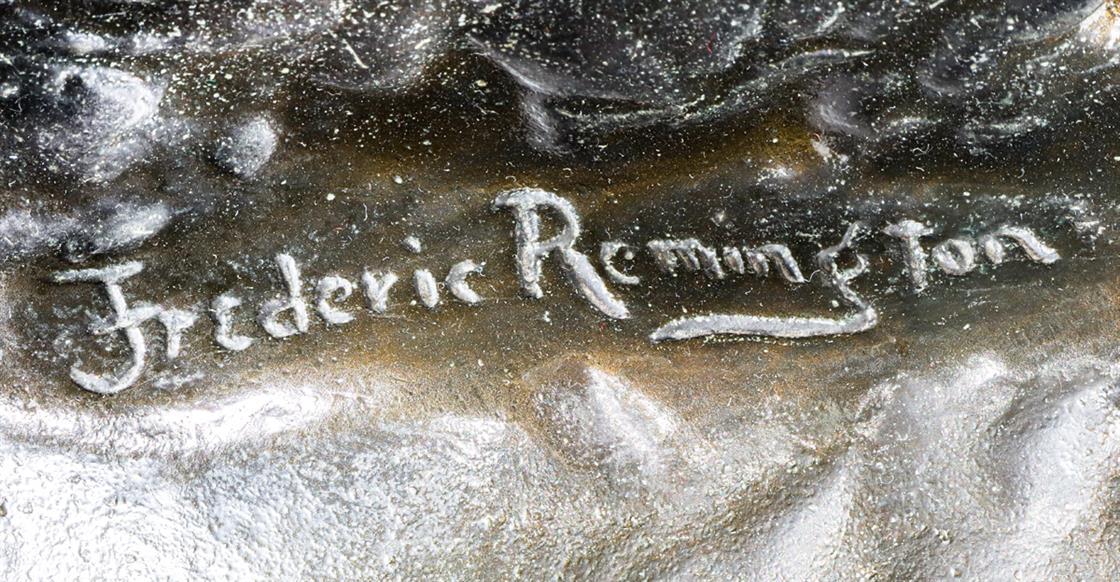
Near fine condition. "Coming Through the Rye," bronze sculpture, after Frederic Remington. Bears signature lower right. Light wear and patina. Missing whip on left-most rider. Left-most rider's gun is slightly bent. Dimensions: 28"H x 25"W x 18"D.
REFERENCES:
Barnes, J. “Frederic Remington—Sculptor.” Collier’s 34, no. 25 (March 18, 1905): 21.
Christie’s. “Frederic Remington (1861–1909), Coming Through the Rye.” Auction lot essay, Lot 12.
Harold McCracken, The Frederic Remington Book: A Pictorial History of the West. Garden City: Doubleday & Company, 1966, 262, no. 369, another example illustrated.
Shapiro, Michael Edward, and Peter H. Hassrick. Frederic Remington: The Masterworks. New York: Harry N. Abrams, 1988.
Accompanied by our company's letter of authenticity.
Pickup available at Colorado
Usually ready in 4 hours
"Coming Through the Rye" Bronze Sculpture, after Frederic Remington
Colorado
1 Lake Avenue
Colorado Springs CO 80906
United States
Choose options
Frequently Asked Questions
FAQs
Yes, all of our Antiques are certified authentic. Every antique comes with a signed Letter of Authenticity that details the item’s history, its current condition including any conservation, binding, or framing work, and the item’s provenance. The Letters of Authenticity are priced valuations by our authentication specialists, who assure that items are original and unconditionally guaranteed as genuine for life.
We pack and ship your items from our gallery in Colorado Springs. You may also choose to come pick up your order. Antique items are carefully packed and insured during shipping. The shipping price will be calculated at checkout.
We acquire from a variety of trusted sources all over the world, but mostly through auctions and private collections within the United States. All provenance information will be listed on the Letter of
Authenticity accompanying your purchase.