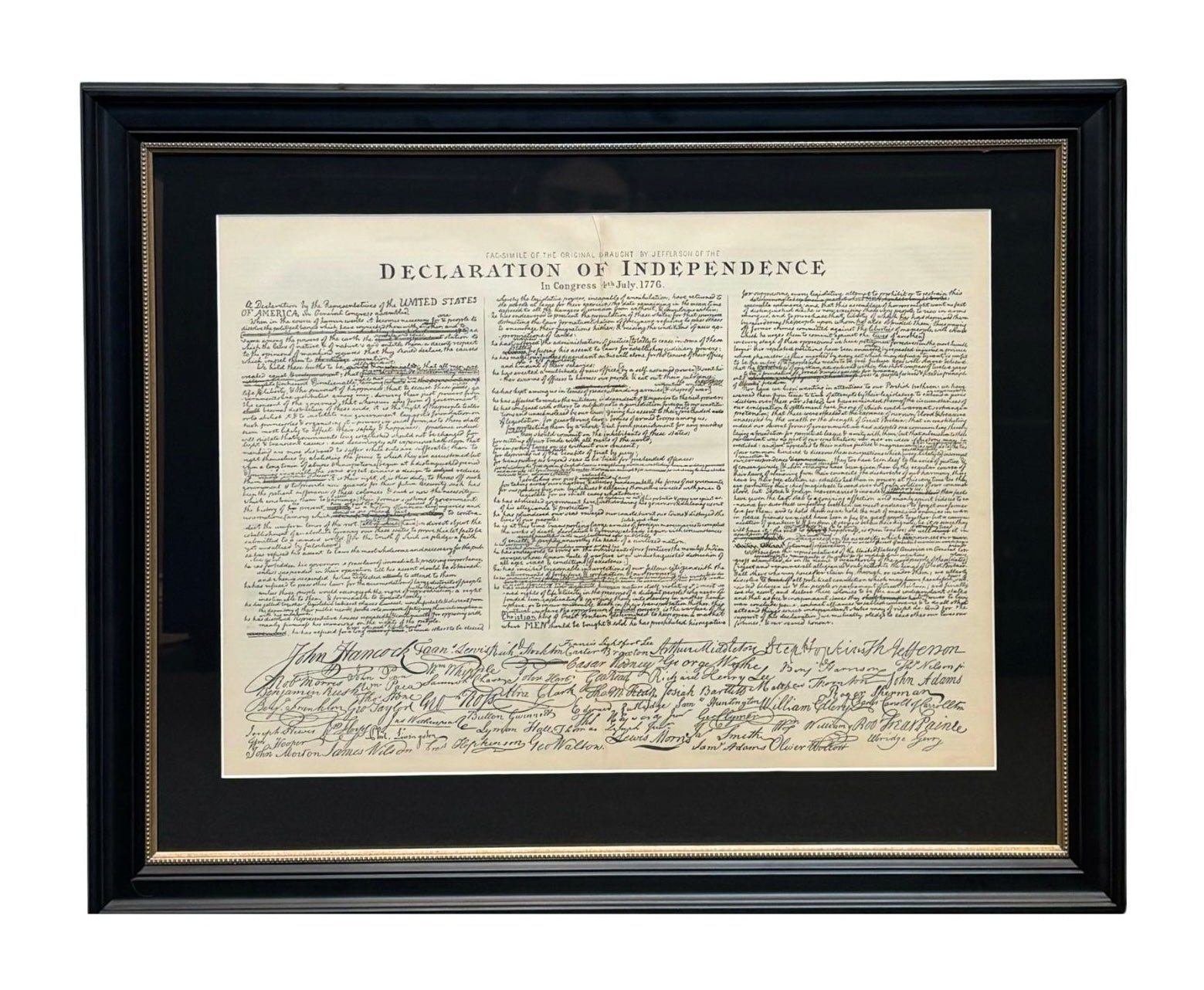
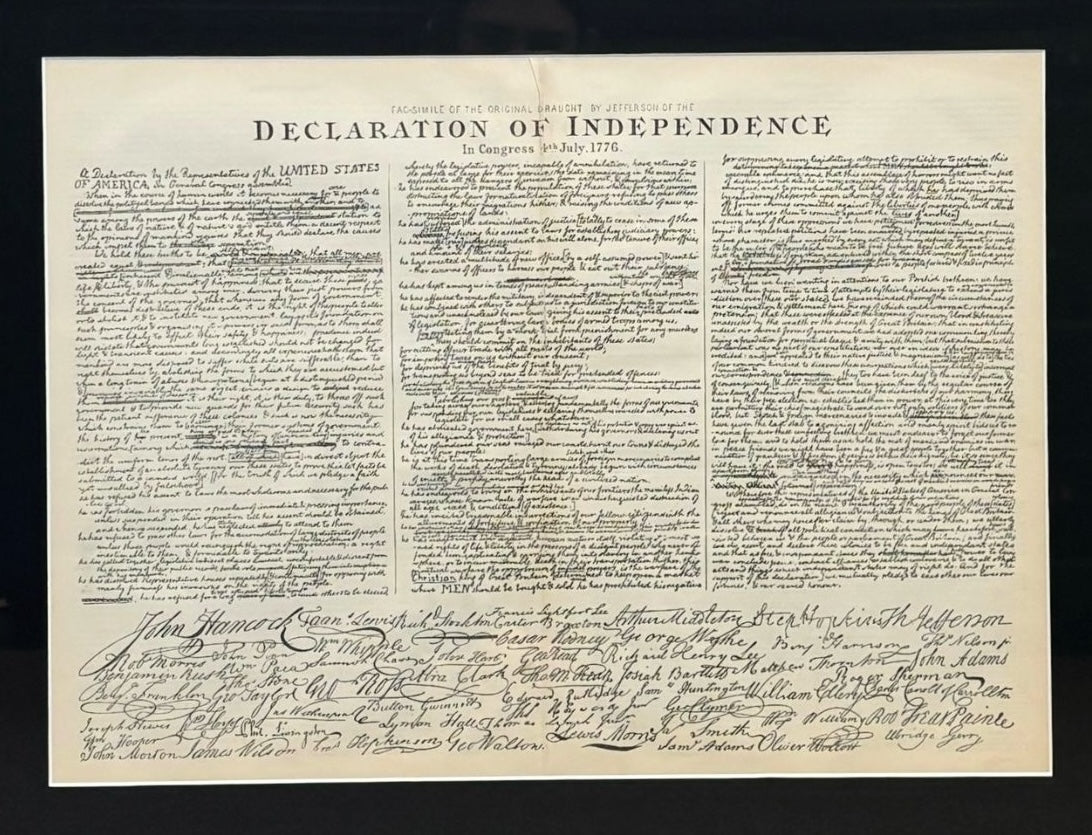
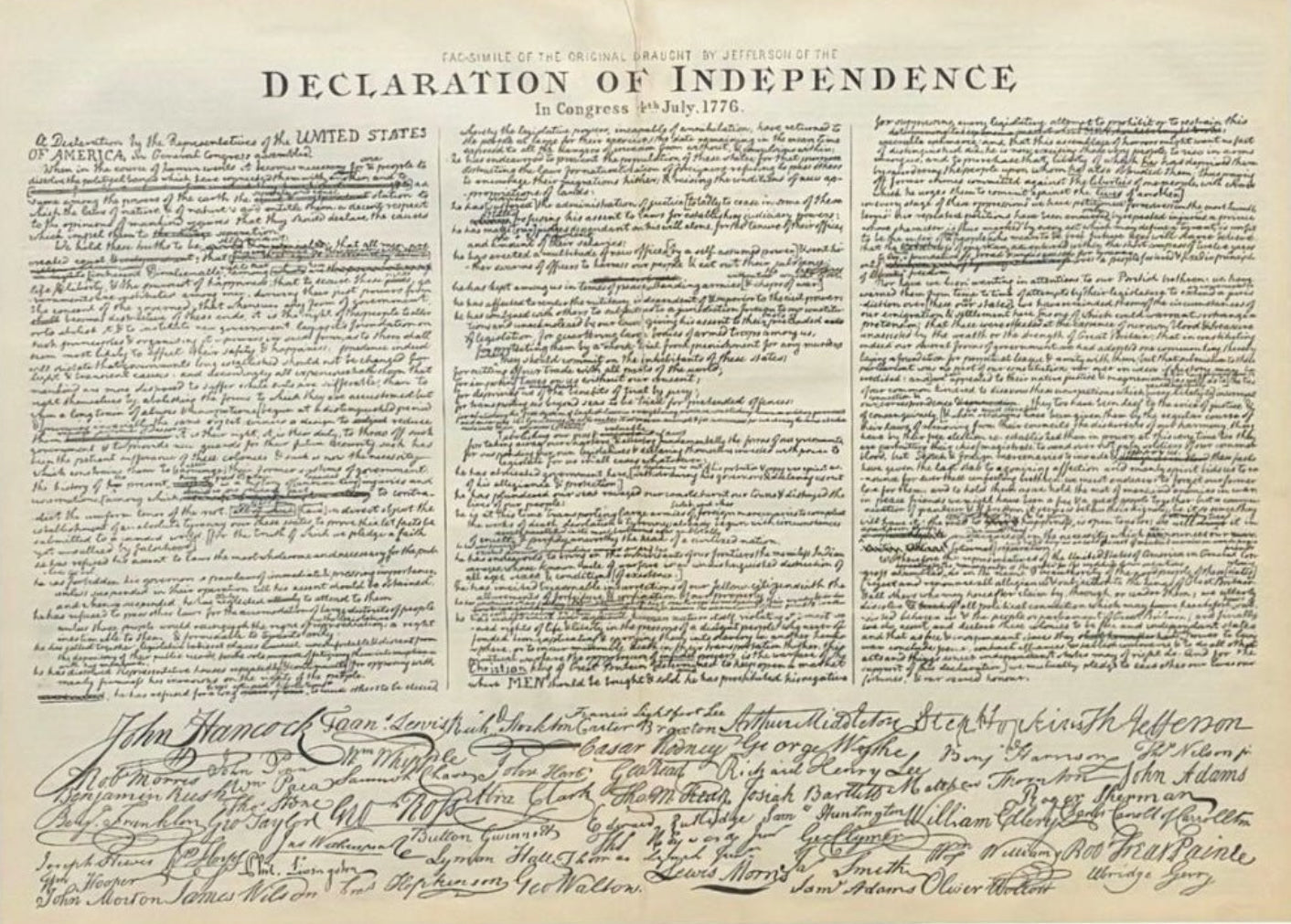
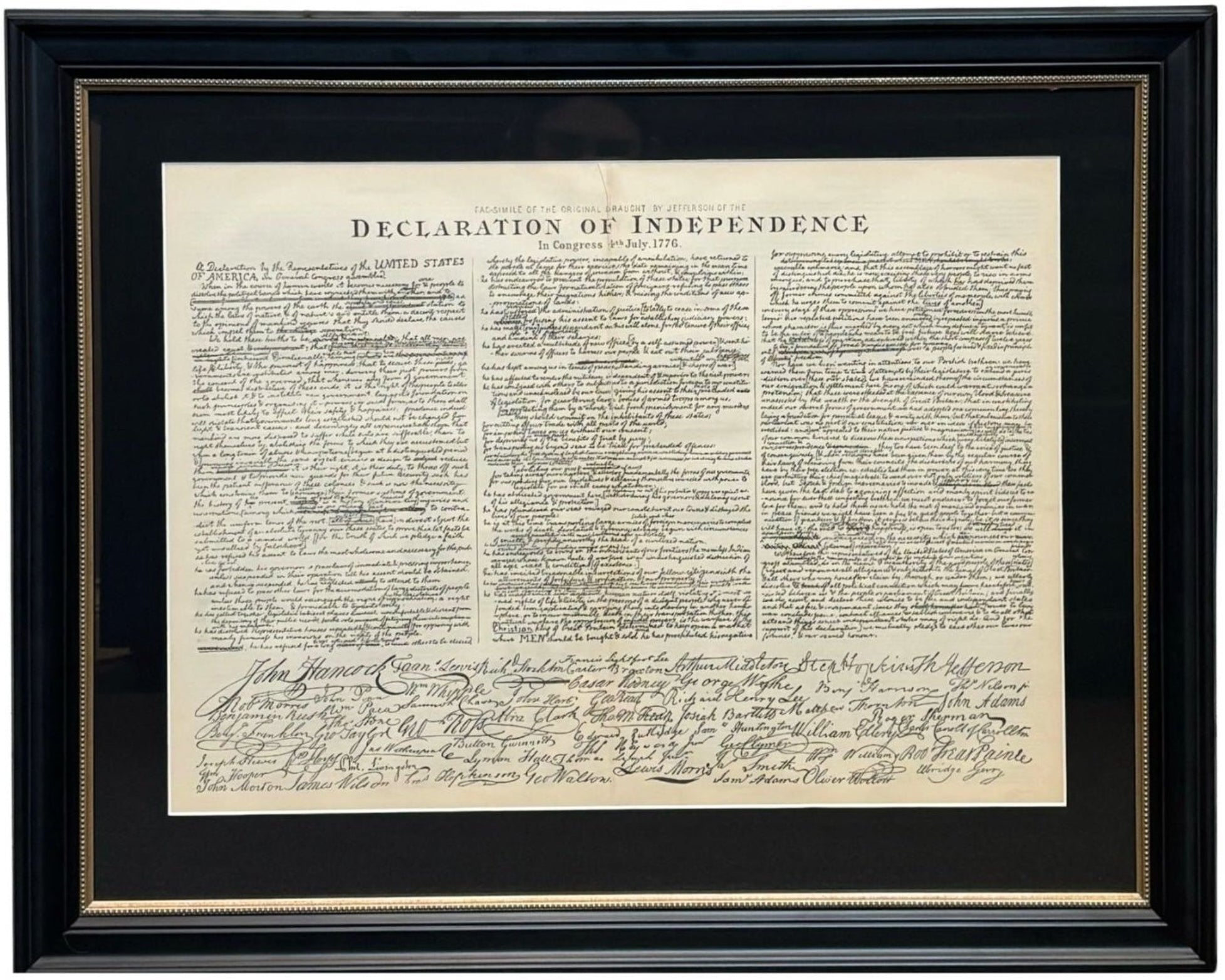
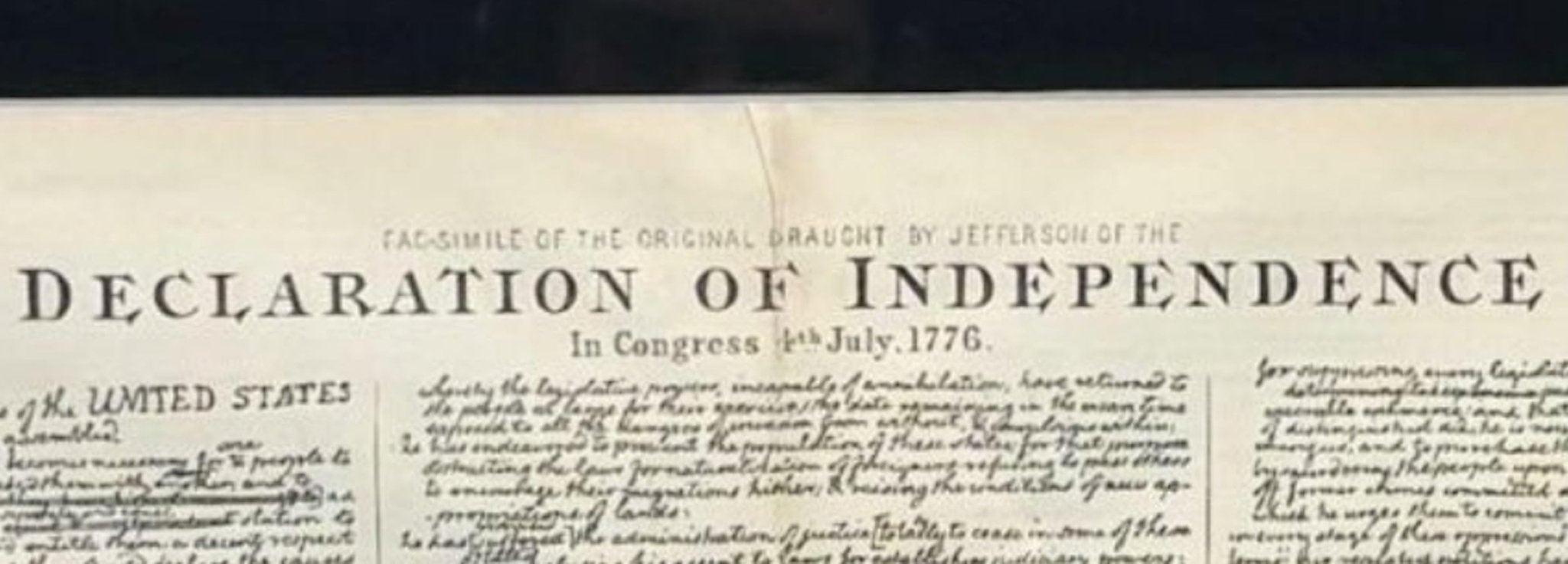
1866 "Fac-simile of the Original Draught By Jefferson of the Declaration of Independence" Engraving, Published by McDonnell Bros.
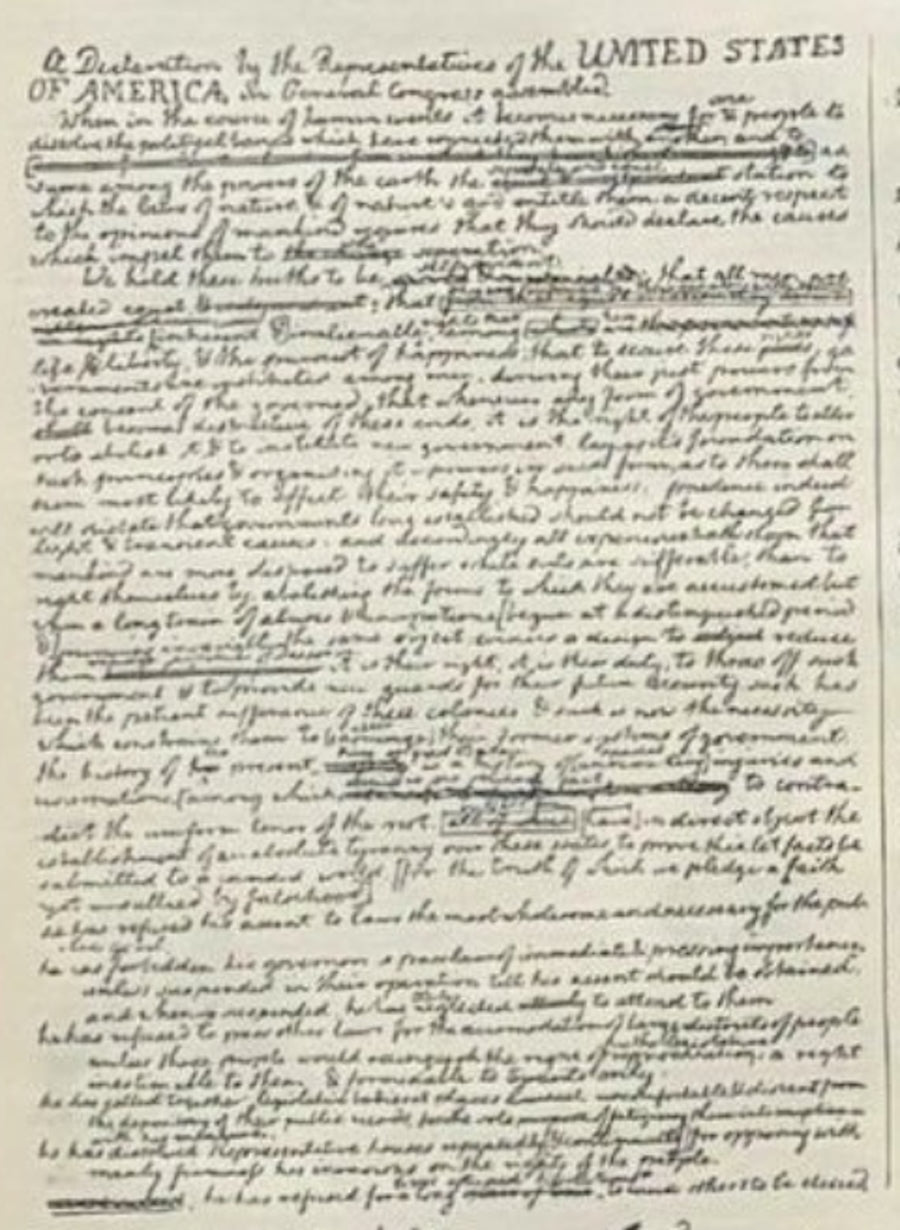
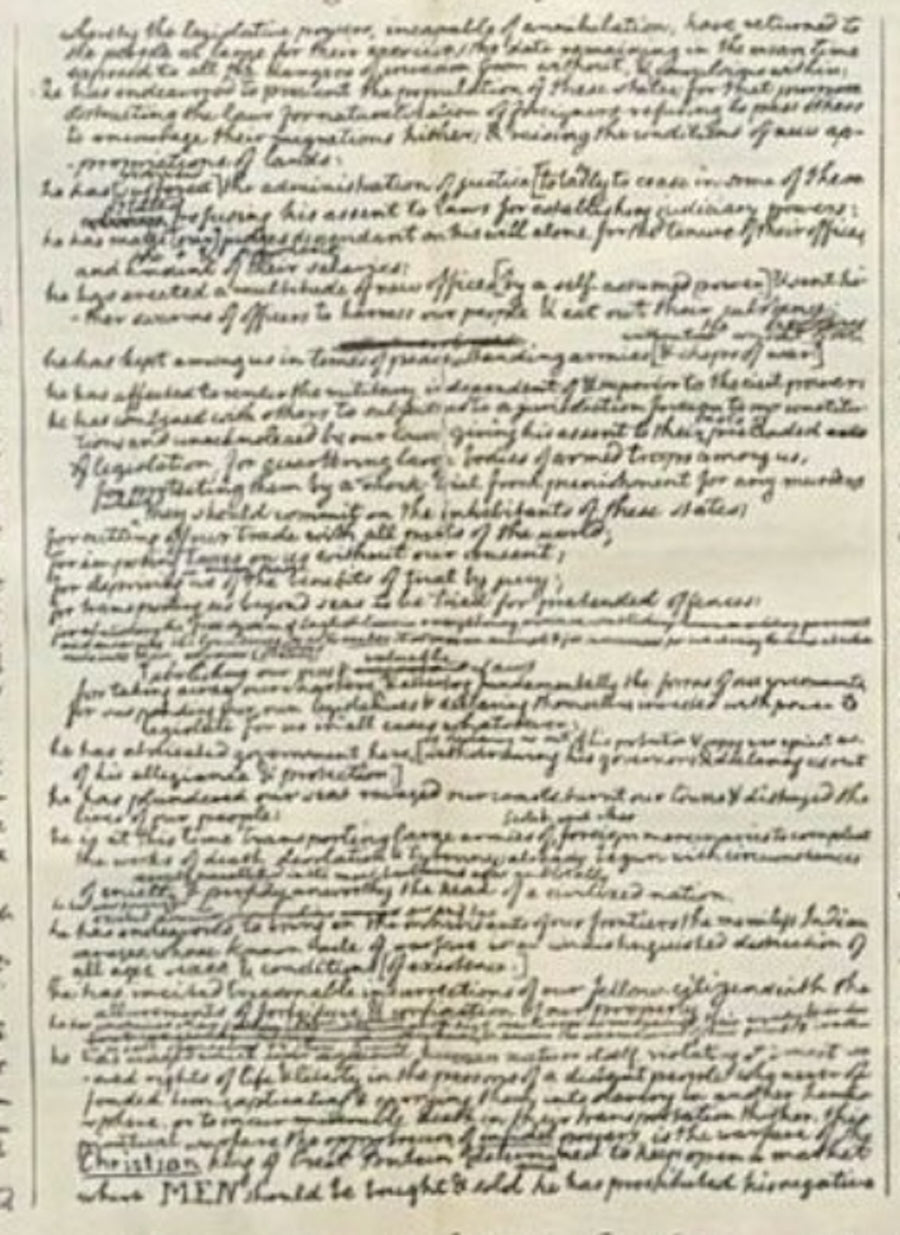
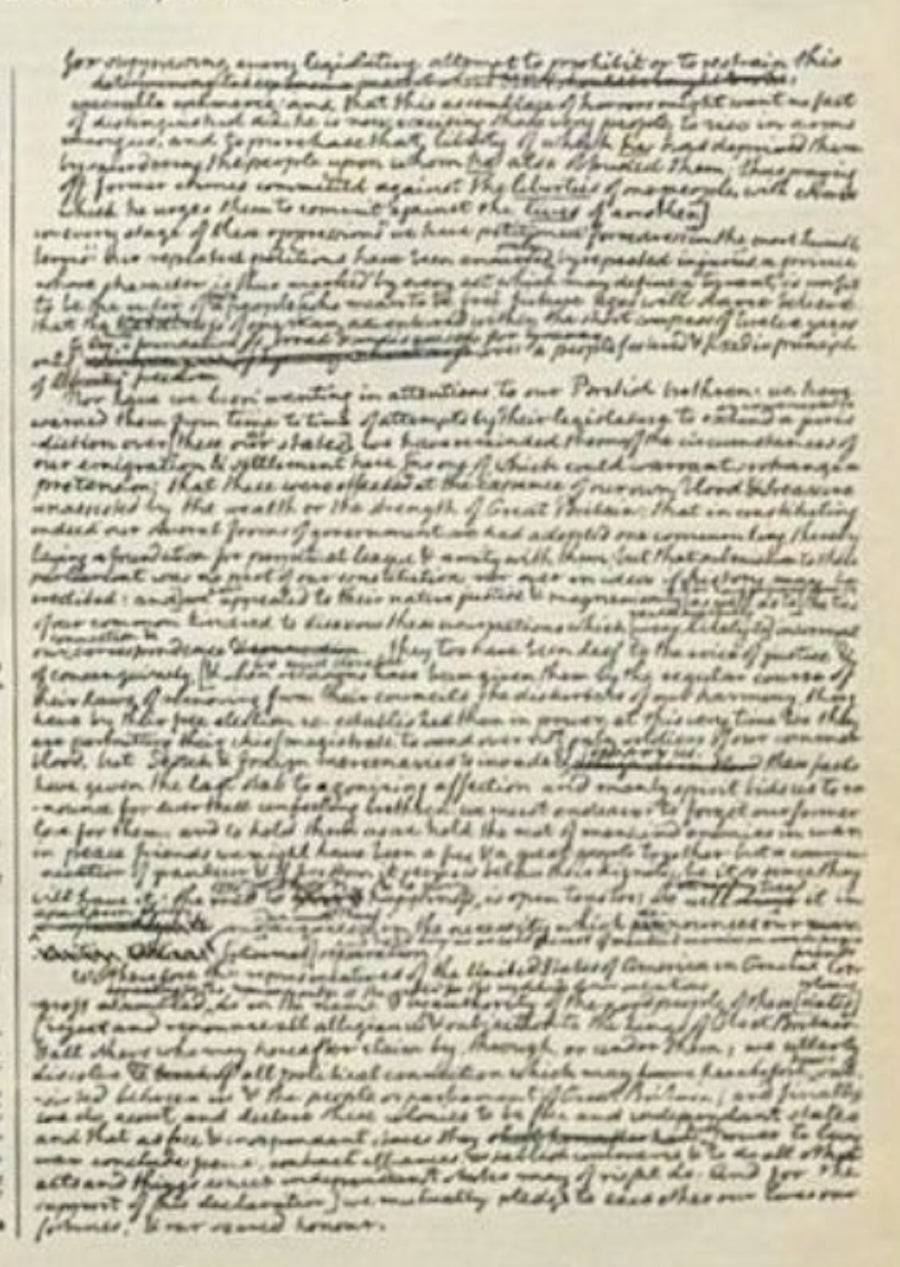
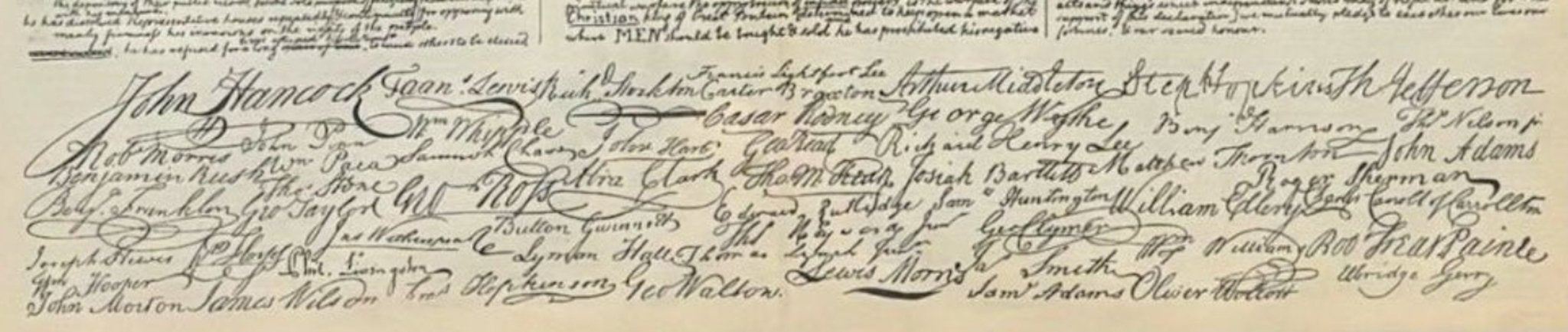
Presented is a wood engraving, entitled "Fac-simile of the Original Draught By Jefferson of the Declaration of Independence, In Congress 4th July, 1776." It is a facsimile engraved draft of the Declaration of Independence, rearranged and printed in three columns, with facsimile signatures printed at the bottom. This is Jefferson’s “Original Rough Draught” with edits, scratch-outs, and re-writing of the text, revealing changes being made to the document as he wrote and submitted drafts to the committee of five, with edits by John Adams and Benjamin Franklin as well. This wood engraving is from Vol I, page 6 and 7 of Harper's Pictorial History of the Civil War. It was included in the “Introduction” chapter, discussing our country's early history.
In early May 1776, Thomas Jefferson made a weeklong journey to Philadelphia to be a delegate to the Second Continental Congress. The Congress appointed a committee of five men to draw up a statement explaining why the colonies wanted independence. They chose John Adams, Roger Sherman, Benjamin Franklin, Robert Livingston, and Thomas Jefferson.
At only thirty-three years old, Jefferson was one of the youngest members of Congress, yet respected for his skill as a writer. The committee chose Jefferson to draft their Declaration of Independence. Over the span of two and a half weeks, writing and rewriting, Jefferson crafted an argument for independence and freedom, and penned perhaps the most celebrated sentence in American History, “We hold these truths to be self-evident, that all men are created equal, that they are endowed by their Creator with certain unalienable Rights, that among these are Life, Liberty and the pursuit of Happiness.”
All that remains of the first handwritten draft is a cut fragment that was found behind a picture frame in 1947. This small portion of Jefferson’s handwritten draft now lives in the archives at the Library of Congress, with the rest of the Jefferson Papers Collection. The fragment shows the process Jefferson went through when writing the Declaration of Independence; there are lots of crossed out sections, scribbles, and errors.
After Jefferson was content with what he wanted to say, he made an unknown number of clean copies to be shared with John Adams, Benjamin Franklin, and other members of the committee so they could add their thoughts and approve what Jefferson had written. Jefferson referred to this copy of the Declaration as the “Original Rough Draught.” This wood engraving shows the content of this “Original Rough Draught.” The majority of the 86 edits seen on this copy of the draft are in the handwriting of John Adams and Benjamin Franklin.
After the rest of the committee read the draft and provided their input, Jefferson made a final document, which included some of the committee’s edits, to be submitted to Congress. This version of the draft, known as the “Fair Copy,” was presented to Congress on June 28, 1776.
Comparing it to the final text adopted by Congress on the morning of July 4, 1776, the “Original Rough Draught” of the Declaration of Independence shows the evolution of the text, from start to finish. Most of the edits on this “Original Rough Draught” are additive, rather than subtractive. Changes such as capitalization, punctuation, inserting a forgotten word, or rephrasing certain sentences were suggested by Franklin and Adams. However, the edits made to the “Fair Copy” draft by Congress were much more extensive. The change Jefferson fought the hardest was the removal of an entire paragraph that attributed responsibility of the slave trade in the colonies to King George III. Although Thomas Jefferson may have thought the removal of this paragraph was cowardly, the rest of his Declaration remained assertive, strong, and decisive and continues to be a sturdy foundational document for the United States of America hundreds of years later.
Harper's Pictorial History of the Civil War, authored by Alfred H. Guernsey and Henry Mills Alden, is a significant two-volume work. Volume I was first published in 1866 and Volume II was published in 1868, printed by McDonnell Bros., in Chicago. It is celebrated for its extensive collection of wood-engraved illustrations, maps, and portraits documenting the American Civil War. Many of the stories and engravings were drawn with minimal alteration from Harper’s Weekly, the most widely read periodical of the era, preserving the immediacy of wartime reportage. As noted by Eicher, the “work delivers the news of the war much as the civilians during the conflict experienced it, and it is therefore both touching and memorable”. Beyond a straightforward chronicle, the work places the war within the broader sweep of American history, offering thoughtful exploration of its causes and a level of analysis made possible only in the years following the war’s end.
CONDITION:
Very good condition. Wood engraving, titled "Fac-simile of the Original Draught By Jefferson of the Declaration of Independence, In Congress 4th July, 1776.” From Vol I, 1866. Pages 6 and 7, from the "Introduction" chapter, discussing our country's early history. Double-page, strong impression with full margins. Crease at centerfold, as expected. 2 1/2" tear (fixed with archival mending tissue) at top center fold, into title, but not into text columns. Light toning, but very good color. Sheet size: 16" H x 21 5/8" W.
Archivally framed in a custom-built wooden frame. Framed Dimensions: 23 1/4"H x 28 1/2"W x 1 1/8"D.
Accompanied by our company's letter of authenticity.
Pickup available at Colorado
Usually ready in 4 hours
1866 "Fac-simile of the Original Draught By Jefferson of the Declaration of Independence" Engraving, Published by McDonnell Bros.
Colorado
1 Lake Avenue
Colorado Springs CO 80906
United States
Choose options
Frequently Asked Questions
FAQs
Yes, all of our Antiques are certified authentic. Every antique comes with a signed Letter of Authenticity that details the item’s history, its current condition including any conservation, binding, or framing work, and the item’s provenance. The Letters of Authenticity are priced valuations by our authentication specialists, who assure that items are original and unconditionally guaranteed as genuine for life.
We pack and ship your items from our gallery in Colorado Springs. You may also choose to come pick up your order. Antique items are carefully packed and insured during shipping. The shipping price will be calculated at checkout.
We acquire from a variety of trusted sources all over the world, but mostly through auctions and private collections within the United States. All provenance information will be listed on the Letter of
Authenticity accompanying your purchase.