Article: Three Masters of Illustration: Nielsen, Dulac, and Burd
Three Masters of Illustration: Nielsen, Dulac, and Burd
Among the many artists who helped shape the visual world of children’s literature in the early twentieth century, three of our favorites are Kay Nielsen, Edmund Dulac, and Clara M. Burd. Nielsen and Dulac are particularly associated with the dreamlike and fantastic qualities of fairy-tale illustration, while Burd brought a more intimate and sentimental sensibility to classic children’s stories. Their work is a beautiful example of the remarkable range of early twentieth-century book illustration and the important role artists played in shaping how generations of readers imagined these beloved stories.

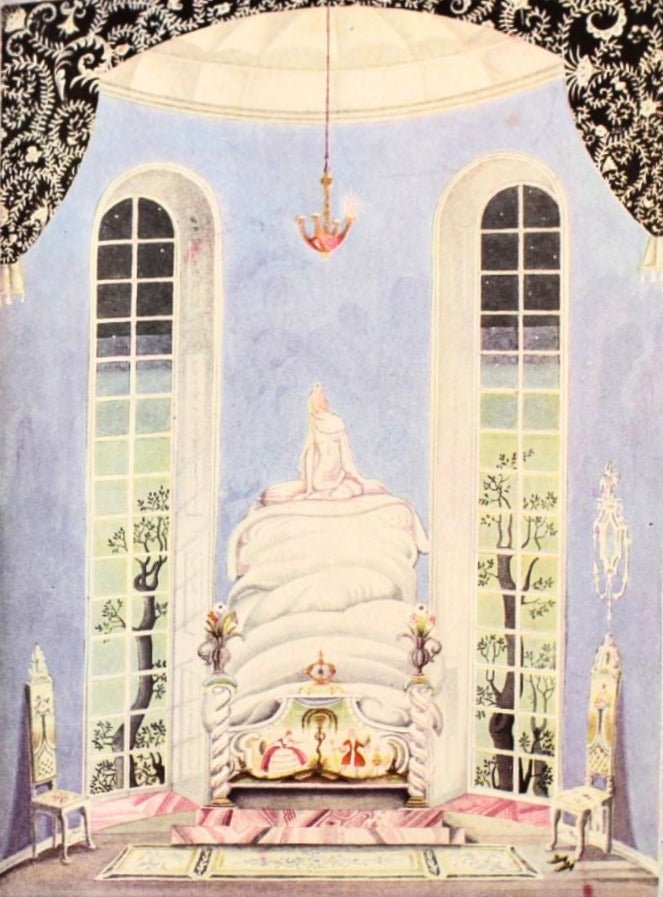
Our 1924 edition of Fairy Tales by Hans Christian Andersen is illustrated by the celebrated Danish artist Kay Nielsen and contains sixteen cherished stories, including “The Nightingale,” “The Snow Queen,” “The Red Shoes,” and “The Real Princess.” The volume is decorated with seven tipped-in, full-color plates and numerous black-and-white in-text illustrations.


Nielsen was one of the leading figures of the early twentieth century’s Golden Age of Illustration. His artwork is distinguished by elegant, stylized figures, flowing Art Nouveau lines, and compositions that evoke an atmosphere of dreamlike fantasy. Drawing inspiration from diverse artistic traditions, including Japanese woodblock prints and European Symbolism, his illustrations combine strong line work with luminous, soft color to create ethereal images. “Nielsen also designed stage sets and costumes, and this theatrical interest showed itself in his book illustration in exotic, stage-like settings and the use of symbolism” (Walley and Chester 1988, 156).

Nielsen illustrated numerous children’s publications, including In Powder and Crinoline, East of the Sun, West of the Moon, Hans Andersen’s Fairy Tales, Hansel and Gretel, and Red Magic. His work for fairy tales during the 1910s and 1920s established him as one of the great interpreters of the genre, alongside illustrators such as Arthur Rackham and Edmund Dulac.

Edmund Dulac’s illustrations for The Sleeping Beauty and Other Fairy Tales From the Old French, retold by Sir Arthur Quiller-Couch, similarly demonstrate the extraordinary visual possibilities of the fairy-tale tradition. This American edition, published in Garden City, New York by Garden City Publishing, dates to the early twentieth century and contains four stories: "The Sleeping Beauty," "Blue Beard," "Cinderella," and "The Beauty and the Beast." The book features seven full-color plates, including a frontispiece depicting a scene from "The Sleeping Beauty."

Edmund Dulac was a French artist who worked as a magazine illustrator, book illustrator, and stamp designer during the early twentieth century. Dulac crafted the most magical scenes from watercolor and ink, creating illustrations that were both delicate and fantastical. “Dulac remained true to the medium of watercolor, and the critics were unanimous in their praise. He was recognized as an illustrator of first rank, a master of the fantastic and exotic and a dreamer of extraordinary dreams” (Dalby, 82-83).


While working in London, Dulac was commissioned by Hodder and Stoughton to produce illustrations for their illustrated gift books, which were published once each year. Among the works he illustrated were Stories from the Arabian Nights, Shakespeare’s The Tempest, and many French fairy tales like The Sleeping Beauty.

Clara M. Burd approached children’s literature from a different artistic perspective, bringing her experience in decorative arts to her illustrations. The 1924 edition of Johanna Spyri’s Heidi, edited by Adeline B. Zachert and published by The John C. Winston Company as part of the “Winston Clear Type Popular Classics Series,” contains four full-color and eight black-and-white illustrations by Burd.

An American illustrator and stained glass artist born in New York City, Burd studied at the Chase School and the National Academy of Design, where she earned a medal of achievement at the age of nineteen, before continuing her training in Paris at the Académie Colarossi under Gustave-Claude-Étienne Courtois, Filippo Colarossi, and other noted instructors. After returning to the United States, she worked as a stained glass designer for the Tiffany Glass and Decorating Company and the Church Glass and Decorating Company, producing important ecclesiastical commissions including the East transept window at Collegiate Church entitled Morning cometh and the shadows flee away and the memorial window for President William McKinley in Canton, Ohio.


Although Burd was accomplished in the decorative arts and mural work, she became best known for her illustrations for children’s literature and her widely circulated magazine covers. She produced richly colored illustrations for classic children’s titles including Louisa May Alcott’s Little Women, Jo’s Boys, and Little Men, as well as Robert Louis Stevenson’s A Child’s Garden of Verse. Her work is characterized by careful attention to costume, domestic interiors, and narrative sentiment. In Heidi, she beautifully creates both cozy interiors and epic landscapes, capturing the innocence and simple joys of nature and childhood.
These three illustrators reveal how richly varied the art of children’s books could be during the late nineteenth and early twentieth centuries, transforming familiar stories through very distinctive artistic approaches.