Article: A Pair of Rare Nineteenth Century Cookbooks
A Pair of Rare Nineteenth Century Cookbooks
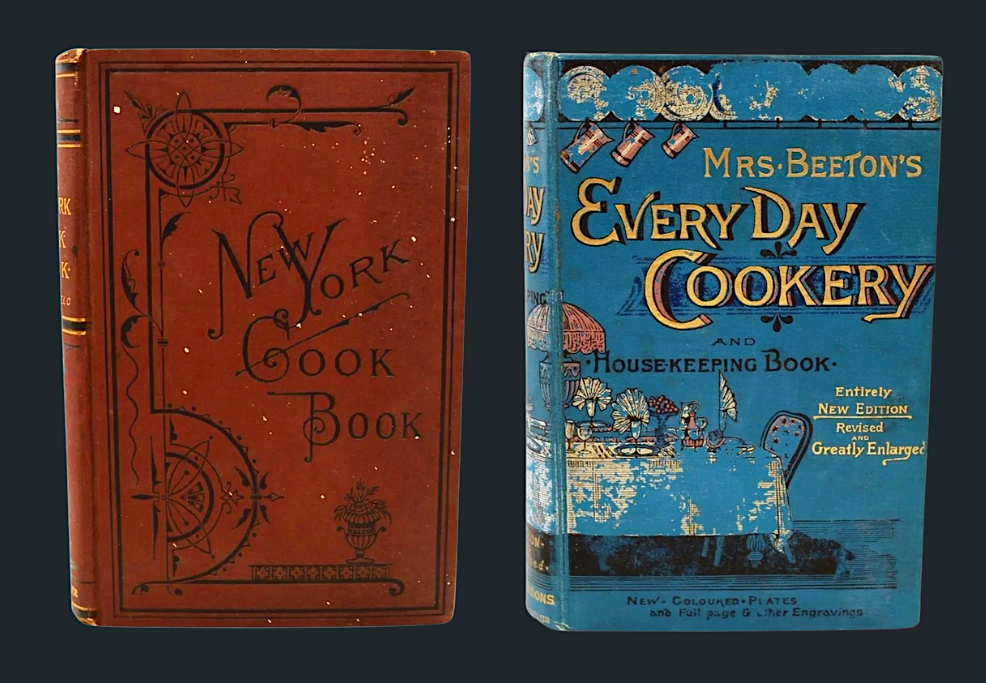
In the 1880s and 1890s, cookbooks occupied a central place in daily domestic life, serving as trusted references. As literacy rates rose and the middle class expanded, these books became indispensable tools for running a home. Cookbooks were not just collections of recipes, but served as comprehensive guides that addressed a whole range of topics, including cooking techniques, healthcare, budgeting, cleaning, and social customs. Volumes such as Marie Martinelo’s The New York Cookbook: A Complete Manual of Cookery, in all its Branches and Mrs. Beeton's Every Day Cookery and Housekeeping Book typify the period’s expectation that a well-run household depended on knowledge, organization, and careful attention to detail.


Martinelo’s The New York Cookbook, published by James Miller, reflects a period when the household was largely self-sufficient, and a single book needed to address a wide range of needs. It proceeds from foundational instruction to increasingly specialized categories, beginning with carving diagrams and methods of cookery before advancing through soups, meats, vegetables, and desserts. Its scope is notable not only for its breadth of recipes but for its inclusion of household formulas and remedies. Directions for making soap, dyes, and ink, as well as guidance on food preservation and the treatment of common ailments, reflects the continued importance of self-sufficiency. Homes were expected to produce and maintain much of what they consumed. As a working reference, this cookbook would have been consulted regularly, offering insight into the rhythms and responsibilities of a nineteenth-century American home.


The enduring popularity of Mrs. Beeton's Every Day Cookery and Housekeeping Book, as seen in the expanded 1893 edition issued by Ward, Lock, Bowden & Co., demonstrates how these manuals evolved to meet the needs of a changing society. By the end of the century, there was a growing emphasis on efficiency, standardization, and the science of cooking. This cookbook incorporates measured recipes, timed cooking processes, and structured meal planning, reflecting that shift toward greater precision in the kitchen. Illustrations, carving charts, tables of weights and measures, seasonal guides, and even advertisements provided readers with a wealth of exact, accessible information in one place.

This expanded edition also addresses the broader management of the household, including budgeting, provisioning, and the coordination of meals for both everyday living and formal entertaining, including table settings and the pacing of multi-course meals. It also assumes a more stratified household and emphasizes oversight, training, and efficiency of kitchen and household staff. It extends well beyond cooking into the orchestration of the entire domestic sphere.
These two remarkable volumes illustrate the evolving role of the cookbook during the late nineteenth century, documenting changing approaches to cooking, household management, and everyday domestic life. Whether consulted as practical manuals or appreciated today as rich historical records, they offer a fascinating window into the homes and routines of that era. I invite you to explore both books in greater detail through their listings on our website (here and here), where you can learn more about their history, contents, and significance.