Skip to content

Cart

Your cart is empty

Article: Collecting Vintage Silver Keepsake Boxes

Collecting Vintage Silver Keepsake Boxes

Trinket or jewelry keepsake boxes have taken on many forms since their first conception in ancient times. However their purpose remains the same; to store jewelry and other items precious to the owner. 

Originally, these boxes were used specifically for jewelry. These were in common use as early as 5000 BC in Ancient Egypt, when the majority of Egyptians, both male and female, wore jewelry. Boxes were used to keep these gemstone-encrusted items safe. In Ancient Rome, rings and brooches were utilized to represent one's status in society. Boxes were needed for security and storage purposes. Finding early examples of these are quite rare. 

Victorian and Edwardian examples of trinket boxes are far more common. This is because owning jewelry– let alone possessing so much a box was needed to store it all– was a luxury before the Victorian era. After the industrial revolution, fine jewelry became available to the masses due to the reduction in production costs. This led to a demand for trinket boxes, which were much smaller than jewelry boxes and therefore better suited to the needs of the middle class who did not yet possess an abundance of jewelry.
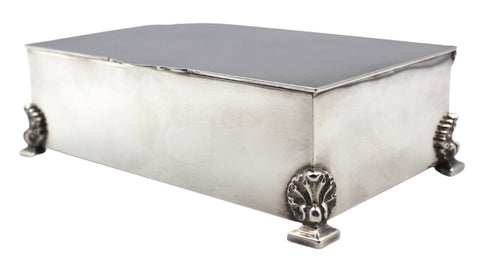
Silver Plated Keepsake Box, Early 20th Century

In Victorian households, collectables and other items of interest were also stashed inside these boxes. This is why they are known as trinket or keepsake boxes, rather than just jewelry boxes. Trinket boxes were produced in large numbers around this time. Many were lined with colored velvet or rich wood. More elaborate designs had interior divisions and trays for rings and other pieces of jewelry. It was also common to see trinket boxes so small that they could only contain one item, such as a single ring or bracelet.
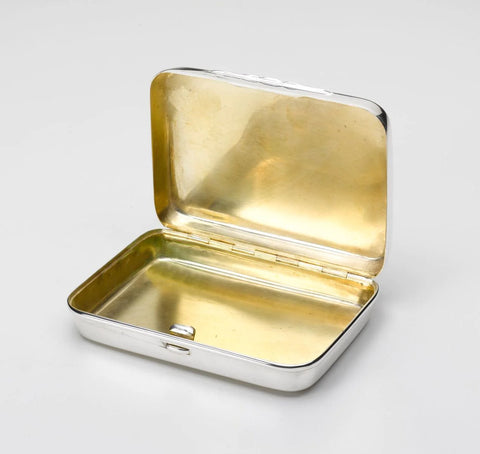
Hallmarked Silver Plated Keepsake Box - Sheffield, UK, Circa 1900

The Edwardian era saw the introduction of new styles of trinket box. These included small circular or oblong boxes that stood raised on cabriole legs. These often featured lids made of tortoiseshell or other luxurious materials.

Hallmarked Silver Plated Keepsake Box - Sheffield, UK, Circa 1900

In the 1900s through the 1930's more streamlined and modern Art Deco styles became popular. Most of the keepsake boxes we have date from this era. To see our whole collection of vintage silver or silver-plated keepsake boxes, click here.  

Read more

Bleeding Kansas: The Eve of the Civil War - The Great Republic
American Flag

Bleeding Kansas: The Eve of the Civil War

Bleeding Kansas was a time of intense violence over slave and non-slave states in the mid 19th century. Read more about this period- what is known as the precursor to the Civil War.

Read more
Grosset & Dunlap: Book Publishers for the Masses and Film Buffs Alike - The Great Republic
19th Century

Grosset & Dunlap: Book Publishers for the Masses and Film Buffs Alike

In 1914, theAmerican book publishing company of Grosset & Dunlap publishers their first photoplay. Today, these vintage photoplay editions are tracked down by film buffs, bibliophiles, and book...

Read more

Blog posts

John Muir’s "Steep Trails" - The Great Republic

John Muir’s "Steep Trails"

Among this month's newest acquisitions is a very collectible, large paper edition of John Muir's Steep Trails, published by Houghton Mifflin Company in Boston and New York in 1918. This example is ...

Read more
Four Military Memoirs - The Great Republic

Four Military Memoirs

These four influential military memoirs offer firsthand accounts of leadership, combat, and innovation across the two World Wars, tracing America’s rise as a global military power and the evolution...

Read more
Douglas Adams’ Highland Scenes - The Great Republic

Douglas Adams’ Highland Scenes

Douglas Adams was a celebrated late Victorian landscape and sporting artist known for dramatic Highland scenes that paired hunting, fishing, and golf with vast, atmospheric natural settings. This p...

Read more
Back to the top