Classic Fairy Tales and Fables in the Golden Age of Illustration
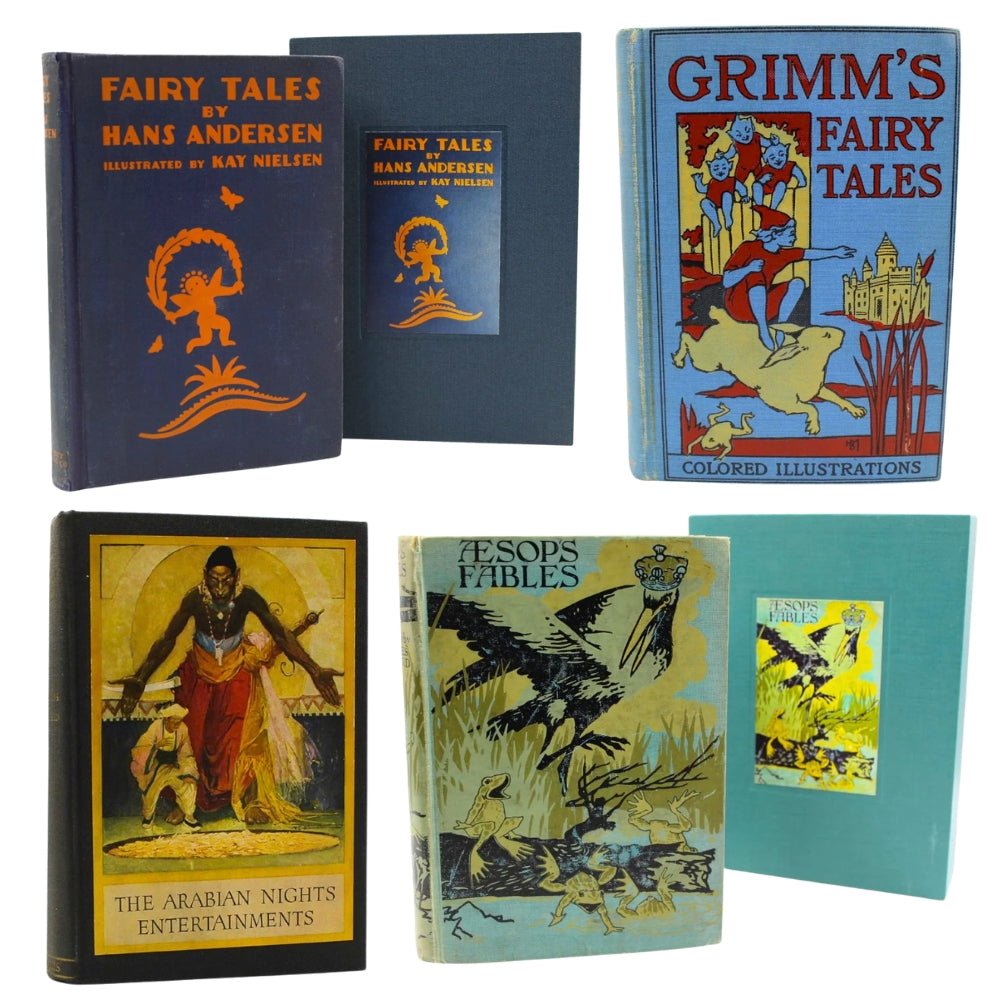
The early twentieth century produced some of the most visually compelling and collectible editions of classic fairy tales and fables, as publishers sought to bring longstanding narratives to new audiences by way of richly illustrated gift books. Among the most appealing examples in our current Great Republic rare book collection are the 1924 American edition of Fairy Tales by Hans Christian Andersen, the David McKay “Colored Classics” issue of Grimm’s Fairy Tales, the 1916 illustrated printing of Aesop’s Fables, and the Harper & Brothers 1925 edition of The Arabian Nights Entertainments. Though they differ widely in origin and approach, each book is a beautiful example of the transmission of traditional storytelling into the modern illustrated book.

Hans Christian Andersen’s Fairy Tales collection reflects the moment when fairy tales became fully literary rather than simply collected folklore. Hans Christian Andersen first issued his tales in the 1830s, beginning with the modest Copenhagen publication Eventyr, fortalt for Børn, released in installments between 1835 and 1837. Unlike earlier compilers, Andersen did not simply record old stories but rather he authored them in a distinctive voice, blending fantasy with emotional realism. Stories such as “The Snow Queen” and “The Red Shoes” reveal a depth of psychological insight that helped elevate the fairy tale into serious literature. By the time this 1924 American edition appeared, Andersen’s work had already been translated widely and embraced internationally. Its appeal is greatly enhanced by the illustrations of Kay Nielsen, whose elegant, stylized compositions reflect the influence of Art Nouveau during the Golden Age of Illustration. Editions illustrated by Nielsen are especially prized, both for their beauty and for their role in shaping the visual identity of these stories for modern readers.

In contrast, Jacob Grimm and Wilhelm Grimm first published Kinder- und Hausmärchen in 1812 as part of a broader scholarly effort to document and preserve German oral traditions at a time of rising national consciousness. Their early editions were not intended specifically for children and retained a starkness and violence that reflected their folkloric roots. Over the course of the nineteenth century, however, the Grimms revised the collection repeatedly, softening certain elements and expanding the number of tales, gradually transforming the work into a cornerstone of children’s literature. What began as an effort tied to emergent ideas of German cultural identity became, over successive editions, a cornerstone of Western narrative tradition. This American publication of Grimm’s Fairy Tales, part of McKay’s “Colored Classics” series, underscores the extent to which these tales had crossed linguistic and national boundaries, becoming part of a shared cultural vocabulary. The inclusion of artwork by E. H. Wehnert adds another layer of appeal, translating the sometimes austere narratives into a more accessible and engaging visual form.

Aesop’s Fables stands apart as the oldest tradition represented in our book collection, yet it remained just as relevant to early twentieth century readers. Attributed to Aesop, a Greek storyteller believed to have lived between approximately 620 and 560 BCE, these brief moral tales have circulated for over two millennia, passing from oral storytelling into written collections and eventually into countless printed editions. Their simplicity is deceptive, as each fable distills a clear moral lesson into a concise and memorable narrative, often using animals as stand-ins for human behavior. The 1916 edition of Aesop Fables, published by Adam and Charles Black and illustrated by Charles Folkard, reflects a period when publishers sought to elevate even the most familiar texts through high-quality production and illustration. With nearly two hundred fables included, this edition offers remarkable breadth, and its combination of full color plates and line drawings makes it a particularly appealing example of the enduring universality of the stories.

Equally rich in history, The Arabian Nights Entertainments represents one of the most complex and layered storytelling traditions in world literature. The tales that make up this collection originated across Persia, India, and the Arab world, evolving over centuries before being gathered into a loosely unified compilation. The famous frame story of Shahrazad, who tells stories to delay her execution, provides a narrative structure for an ever-expanding collection that includes adventure tales, romances, and moral stories. The work entered European literary culture through the early eighteenth century French translation of Antoine Galland. Galland not only translated but also introduced stories such as “Aladdin” and “Ali Baba,” which became some of the most famous in the collection despite not appearing in earlier Arabic manuscripts. By the early twentieth century, the text had become firmly established in Western publishing, and this 1925 Harper & Brothers edition, illustrated by Louis Rhead, exemplifies the era’s fascination with richly decorative and imaginative book design. The abundance of illustrations in this edition (over one hundred!) enhances its desirability and reflects the continuing allure of these stories.
These four works illustrate both the diversity and the shared foundations of the fairy tale and fable tradition. Each draws on storytelling practices that originated in oral culture, yet each has been shaped by editors, translators, and authors in different ways. Hans Christian Andersen’s tales are highly literary and physiological approaches to fairy tales, the Grimms’ work is rooted in cultural preservation, Aesop’s Fables represent a longstanding moral tradition, and the Arabian Nights Entertainments reflects a fluid, evolving body of stories shaped across regions and centuries. What unites them is their lasting cultural impact. These stories have provided generations of readers with moral lessons, imaginative worlds, and enduring narrative patterns that continue to influence literature, film, and art.
For collectors, early twentieth century illustrated editions such as these offer a particularly appealing entry point into these traditions. They reflect a period in which publishers sought to recontextualize inherited narratives for new audiences, combining these classic tales with art by some of the best illustrators of the day.